
Your Own Show Garden: How to Steal the Best Ideas From Bord Bia Bloom 2026
On this page
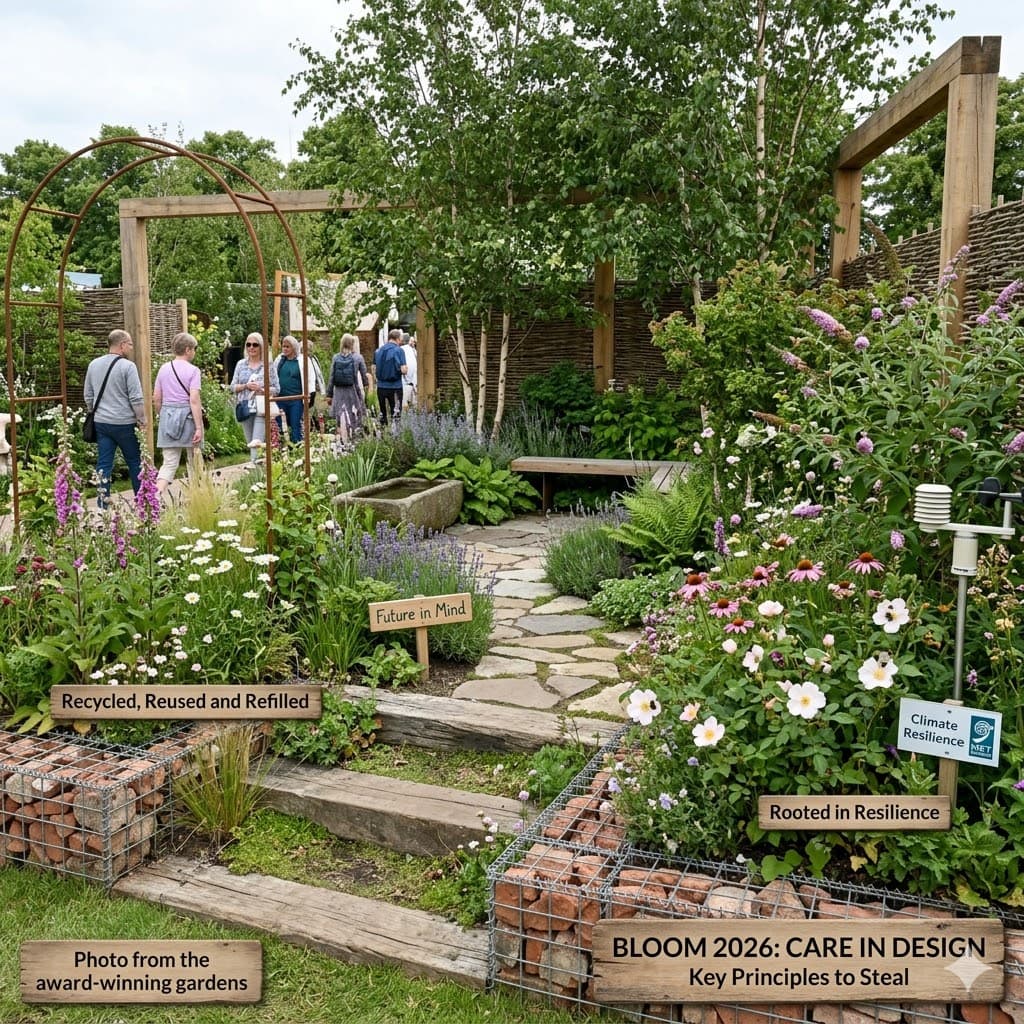
Bord Bia Bloom wrapped up at the Phoenix Park last Monday after its 20th run. Twenty show gardens, eleven gold medals, around 100,000 visitors moving through the gates over five days. If you went, you probably walked away inspired. If you didn't, you may have spent time afterward scrolling photos of someone else's idea of a perfect garden and wondering whether your space could ever look like that.
Most show-garden inspiration dies in the car park on the way home. The gardens are spectacular and you know it. What you don't quite see is the budget that runs comfortably into five figures, the two-week build by a ten-person team, the fact that the garden is designed to peak for five days in late May, and that nobody is asking it to look respectable and be available for use in February. Thats the gap where the inspiration usually dissolves.
But those same principles that make a Bloom garden work, the design decisions underneath the budget and spectacle, are mostly the same principles that could lift your back garden. Some of them are properly free. So heres a summary of what stood out at Bloom 2026 and how to use it at home.
A Quick Read on Bloom 2026
This year's 20 show gardens shared a single theme: Care. Care for environment, mental health, communities, food, and the small patch of ground you actually own. The big wins reflected that. The overall large-garden award went to James Purdy's 'Recycled, Reused and Refilled Sculptural Garden' for Repak, built largely from reclaimed materials. The overall medium-garden award went to Joe Eustace's 'Future in Mind' for the Mental Health Commission, which also took the Designers' Choice. The People's Choice went to 'Rooted in Resilience' by David Negus.
Elsewhere on the field, Fingal County Council picked up the Most Sustainable Garden Award for 'Nurturing Communities through Nature'. Met Éireann marked 90 years with a garden designed around climate resilience. And the Cultivating Talent winner, Jack Donovan, debuted 'Alltar', a garden built on the idea of spontaneous vegetation taking hold in disturbed ground.
You can see the through-line. Sustainability, mental health, biodiversity, resilience. The trend isn't decoration; it's how you spec materials and plants from the first decision.
Six Principles Worth Stealing
1. Pick one idea, not all of them
Every Bloom show garden has a single thesis. You can write each one in a sentence. A garden built from reclaimed material. A garden as a place to think about mental health. A garden that lets disturbed ground heal itself. That clarity is what makes them legible from the path. They're not trying to be six things.
Most home gardens fail the opposite test. They try to do everything: dining, kids, herbs, low maintenance, formal hedges, wild meadow, water feature. The result reads as undecided. What we've found, working with homeowners across the country, is that the most useful design exercise is naming the garden's single primary purpose. Everything else is secondary, and the secondary things become much easier to arrange once the primary is named. Our note on where to begin with a garden redesign walks through this in more depth.
2. Repetition beats variety
Walk Bloom and the gardens that read best have far fewer plants than you'd expect. The borders are built on five or six species in deliberate groups, not thirty species scattered. The eye reads repetition as intention; it reads variety as a garden centre receipt.
Show gardens use this for instant legibility, but you should use it because it's how a planting composition becomes greater than the sum of its parts. A small back garden planted with twelve species in groups of five reads as more abundant and considered than the same garden planted with thirty species individually. It also costs less to maintain. We've covered this discipline in our small Irish garden design guide.
3. Plant for the climate you have, not the catalogue
The headline planting at Bloom 2026 was naturalistic, climate-resilient, and built around supporting biodiversity. The Met Éireann garden put climate resilience at the centre of its brief. Jack Donovan's 'Alltar' used pioneer plants that thrive in disturbed ground. The Bord Bia Bloom write-up of this year's design talent points to "spontaneous vegetation" as a deliberate idea, not a happy accident. The trend is consistent because the climate is consistent: longer growing seasons, wetter winters, more weather extremes.
The translation home is straightforward. Stop fighting the climate. Plants that genuinely suit Irish and British conditions, drainage and exposure included, outperform exotic species you have to nurse along. Our beginner's guide to plant hardiness covers how to read the H1 to H7 scale and where your garden actually sits on it. The companion note on plants that earn their keep is a working shortlist of what consistently thrives in our climate, calibrated against the same conditions Bloom's planting designers are working with.
4. Structure first, planting second
Every show garden at Bloom has its bones in by the time the first plant lands. Paths, walls, levels, focal points. The planting fills out a layout that's already legible.
The instinct in a home garden is the reverse. You see a beautiful plant, you buy it, you put it somewhere, and the garden never quite holds together. What we've found is that the gardens that look effortlessly good in every photograph share one thing in common: strong structure. A clear path. A defined edge between the lawn and the border. A focal point of some kind. Structure does more heavy lifting than any plant selection, and it holds its shape through winter when everything else has died back.
5. Wildlife is no longer optional
Pollinator-friendly planting wasn't a corner of Bloom 2026. It was the default. Naturalistic borders, native species, plants chosen for habitat value as much as for visual impact. Several gardens were built explicitly around biodiversity briefs.
This is the easiest principle to take home, because most of it costs nothing. It's a decision, not a budget item. Switch double-flowered cultivars for single-flowered varieties (pollinators can actually feed off the simple ones). Leave a corner long. Stop spraying. Put in three months of late-summer flowering. Our note on eight features that turn a garden into a pollinator haven walks through the specific moves that make a real difference.
6. The Care theme is the maintenance question in disguise
The 'Care' theme at Bloom 2026 was intentional and well-judged. But the gardens themselves get five days of spectacular bloom and a team of fifteen tending them. Yours has to look good for years, with whatever time you can actually give it.
What we've found is that the gardens that age well are the ones designed honestly against the homeowner's actual maintenance capacity. A high-maintenance scheme owned by a low-maintenance gardener is a slow disappointment. Be straight with yourself about how much time you'll spend, and design to that. Our low maintenance garden ideas by climate zone covers what 'low-maintenance' actually means once you take it seriously.
The Bit Nobody at Bloom Tells You
Three things from the show gardens don't make it home, and it's worth saying so out loud. The first is budget. A top show garden runs into five figures comfortably; gold medal winners often deep into them. The second is time scale. Those gardens are built in two weeks by a team and designed to peak for five days. The third is maintenance. Show gardens are spectacle. Home gardens are commitment.
The trick is using show gardens as a sketchbook, not a copy. Steal the principle, not the plant list.
Where to Start at Home
The smaller gardens at Bloom 2026 (the balcony plots, the family-budget gardens, the novice-friendly designs by Carleen Osborne's 'I Can Create That Garden') were arguably the most useful for the rest of us, because they were designed under the same constraints we work with. Limited space, limited budget, limited time. If you went and only have time to revisit one corner of the field in memory, those are the ones worth revisiting.
If Bloom 2026 left you wanting more from your own space, the practical first move is the same one every show garden designer makes before they touch a plant: spend an afternoon understanding your site. What's the aspect? Where does water sit? What's already working that should stay? Our note on landscape paralysis covers why this step is hard for most homeowners and how to break out of it.
Then, when you're ready to translate it into something specific, that's the bit we built dedrab for. Upload a single photo of your garden and we turn it into a plan with the same structural discipline a show garden brings, sized for your space, your climate, and your budget. Not a show garden. The version of your own garden that's worth looking at every morning.
Related Notes
- Plant Hardiness in Ireland: A Beginner's Guide to What the Ratings Actually Mean
- How to Design a Small Garden That Actually Works All Year
- Plants That Earn Their Keep in a Temperate Garden
- 8 Features That Turn a Garden Into a Pollinator Haven
- Landscape Paralysis: Why You Want a Beautiful Garden and Still Haven't Started
- Low Maintenance Garden Ideas by Climate Zone
A plan that takes a show garden's discipline and shrinks it to your real space, your real climate, and your real budget is the gap dedrab was built to close. Upload a single photo and the action plan comes back with planting, materials and phasing already specified. Try it at dedrab.com.
References
- Bord Bia Bloom, Green and Gold — Bloom's Big Winners Champion Sustainability and Mental Health
- Bord Bia Bloom, Gardens That Care — Introducing the 2026 Show Gardens
- RTÉ News, Around 100,000 expected to attend Bloom gardening festival
- The Irish Times, Met Éireann puts the focus on climate 'resilience' with timely Bloom Show Garden
- Garden Guide Ireland, Trees and forests in our lives at Bloom 2026
- Garden Guide Ireland, Nature in Balance — Bord Bia Bloom Gold Medal Winner
- RTÉ Lifestyle, 6 things to see and do at Bloom 2026