
Landscape Paralysis: Why You Want a Beautiful Garden and Still Haven't Started
On this page
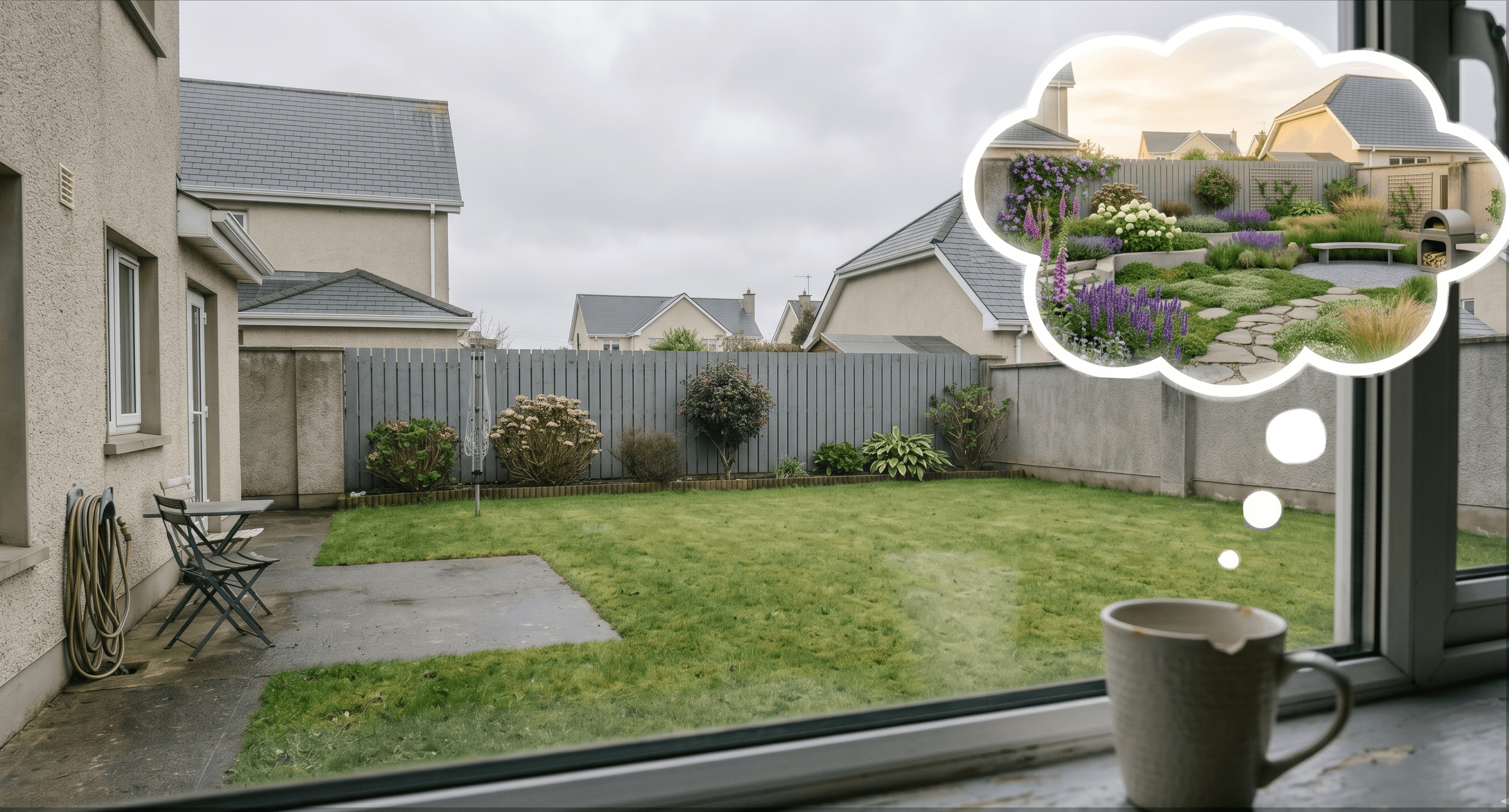
There's a particular kind of Sunday afternoon that most Irish homeowners know well. You're standing at the back door, mug in hand, looking out at a lawn that is technically fine. Green. Flat. Unoffensive. And you feel absolutely nothing.
Somewhere on your phone is a folder full of saved images. Lush, layered borders. A Japanese acer catching the autumn light. Stone steps disappearing into something soft and wild and entirely unlike what you have. You know what you want. You just haven't the faintest idea how to get from here to there.
In 2026, we've started calling this Landscape Paralysis — and what we've found, working with homeowners across the country, is that it's far and away the single biggest reason beautiful gardens don't happen. Not budget. Not time. Not even the Irish weather (though it gets the blame). It's the weight of the decision itself.
The Pinterest Problem
There has never been more garden inspiration available, and there has never been a worse time to be a homeowner trying to act on it. Instagram gives you a Provencal gravel garden at 7am and a Japanese moss courtyard by lunchtime. Pinterest serves up a thousand variations on "cottage romantic" before you've finished your coffee. By the time you walk outside with any intention of doing something, your head is full of conflicting aesthetics and you're no closer to a decision.
What we've found is that this isn't a motivation problem. The desire is absolutely there. The problem is cognitive overload — too many options, too many styles, no clear framework for narrowing it down to something that actually suits your space, your soil, and the way you actually use your garden.
The result? You do nothing. The lawn stays as it is. Another season passes.
The Fear Underneath It All
Paralysis is rarely just about too many options. Dig a little deeper and there's usually a specific fear underneath it: the fear of making an expensive, high-maintenance mistake.
And that fear is not irrational. Most of us have seen it play out. A neighbour who planted a beech hedge that needed clipping twice a year. A relative who put in a water feature that turned into an algae management project. A corner border that looked brilliant in May and was a writhing mess of ground elder by August.
The gardening industry has not always helped itself here. Spend any time reading garden centre labels or watching makeover programmes and you'd be forgiven for thinking that every plant is "low maintenance," every design is "easy care," and that a completely transformed space can be achieved over a long weekend with a bit of elbow grease and a good attitude.
What we've found is that the homeowners who feel most stuck are often the ones who've done the most research. They know enough to know what can go wrong. They just don't know enough yet to know how to avoid it.
What "Vibe Gardening" Actually Means
The phrase doing the rounds in garden design circles at the moment is "vibe gardening" — the idea that people aren't designing a garden so much as they're chasing a feeling. The feeling of stepping outside in the morning into something that feels considered. Peaceful. Theirs.
It's not a bad instinct. In fact, it's probably the right place to start.
The mistake is trying to reverse-engineer a specific Pinterest image into your own space. That image was taken on a summer afternoon, by a photographer, in a garden that has been maintained by a professional for eight years. It is not a blueprint. It is a mood board. There is a difference.
What we've found works far better is to start with the feeling and then build backwards from there. What does your ideal garden feel like to be in? Calm and minimal? Productive and a little chaotic? Sheltered and private? Wild at the edges but structured near the house? Once you have that, the decisions that follow — what to plant, what to pave, what to remove — start to have a logic to them.
Breaking the Paralysis: Three Places to Start
If you're in the thick of Landscape Paralysis right now, here's what we've found to be genuinely useful.
Start with subtraction, not addition. Most gardens that feel overwhelming are actually suffering from too much of the wrong things rather than not enough of the right things. Before you buy a single plant or draw a single line, spend one afternoon removing what isn't working. The overgrown shrub that's blocking the light. The rockery that never really landed. The dead hedge. Clearing space creates clarity. If you want a list of small reversible moves that lift a garden in one weekend rather than one season, see our note on how to get a garden from drab to fab.
Pick one season to own. Trying to design a garden that looks brilliant in every season is a recipe for paralysis. What we've found is that homeowners who focus on making one season exceptional — and let the rest take care of itself — end up with gardens that feel genuinely designed rather than assembled. If you love spring mornings, build your planting palette around that. Everything else is a bonus.
Get the bones right before you think about planting. The gardens that look effortlessly good in every photograph share one thing in common: strong structure. A clear path. A defined edge between the lawn and the border. A focal point of some kind — a mature shrub, a seat, a well-placed pot. Structure does more heavy lifting than any plant selection, and it holds its shape through winter when everything else has died back.
The Boring Lawn Isn't the Problem
Here's the thing about that flat, green, technically fine lawn: it's not really the problem. It's a symptom of a decision that hasn't been made yet. And decisions are hard when you don't have a framework for making them.
What we work on with every client who comes to us stuck is exactly this, not the plants, not the paving, but the clarity. What is this garden for? What do you actually need it to do? What would make you want to be in it?
Once those questions have honest answers, the decisions that felt impossible become, if not easy, at least manageable. The paralysis lifts. And eventually, the lawn has competition. Our note on where to begin with a garden redesign walks through the anchor-zone framework we use to turn that clarity into a first move.
Related Notes
- Your Own Show Garden: How to Steal the Best Ideas From Bord Bia Bloom 2026
- Where Do You Actually Begin? A Practical Framework for Garden Redesign
- How Would I Get My Garden From Drab to Fab?
- DIY Garden Makeover Plan: A Realistic Weekend-by-Weekend Guide
- Making Small Gardens Feel Generous: Design Principles That Actually Work
- What Would My Garden Actually Look Like? Seeing Before You Spend
If any of this is landing somewhere familiar, we'd be glad to help you think it through. That's exactly what the design tool is for.