
Making Small Gardens Feel Generous: Design Principles That Actually Work
On this page
Small gardens have been solved before. The principles that make a compact outdoor space feel larger, calmer, and more abundant than its actual dimensions are well documented — in landscape architecture, in urban design, in the work of garden designers who have spent careers working with the kinds of spaces most of us actually have. What we've found is that these principles are rarely about spending more. They are almost always about making better decisions with what you have.
Here is how we think about it.
The Boundary Is the Problem
In a small garden, the boundary is usually the first thing your eye finds. A fence, a wall, a hedge — the edge of the space is visible from almost everywhere in it, and that visibility is what makes the garden feel contained. Managing where and how the eye travels is the central challenge of designing a small space.
The instinct most people have is to plant along the boundary. This is not wrong, but the way it's done matters enormously. A row of identical shrubs at the fence line emphasises the boundary rather than softening it. Layered planting — with variation in height, density, and seasonal interest — creates the impression that there is more beyond what you can see. The eye reads a gap in the planting as a continuation of the garden rather than a fence, even when it isn't.
What we've found works well is to deliberately obscure at least part of the boundary at eye level from the main viewing position. It does not need to be completely hidden — it needs to be ambiguous enough that the boundary does not announce itself.
Sightlines and Focal Points
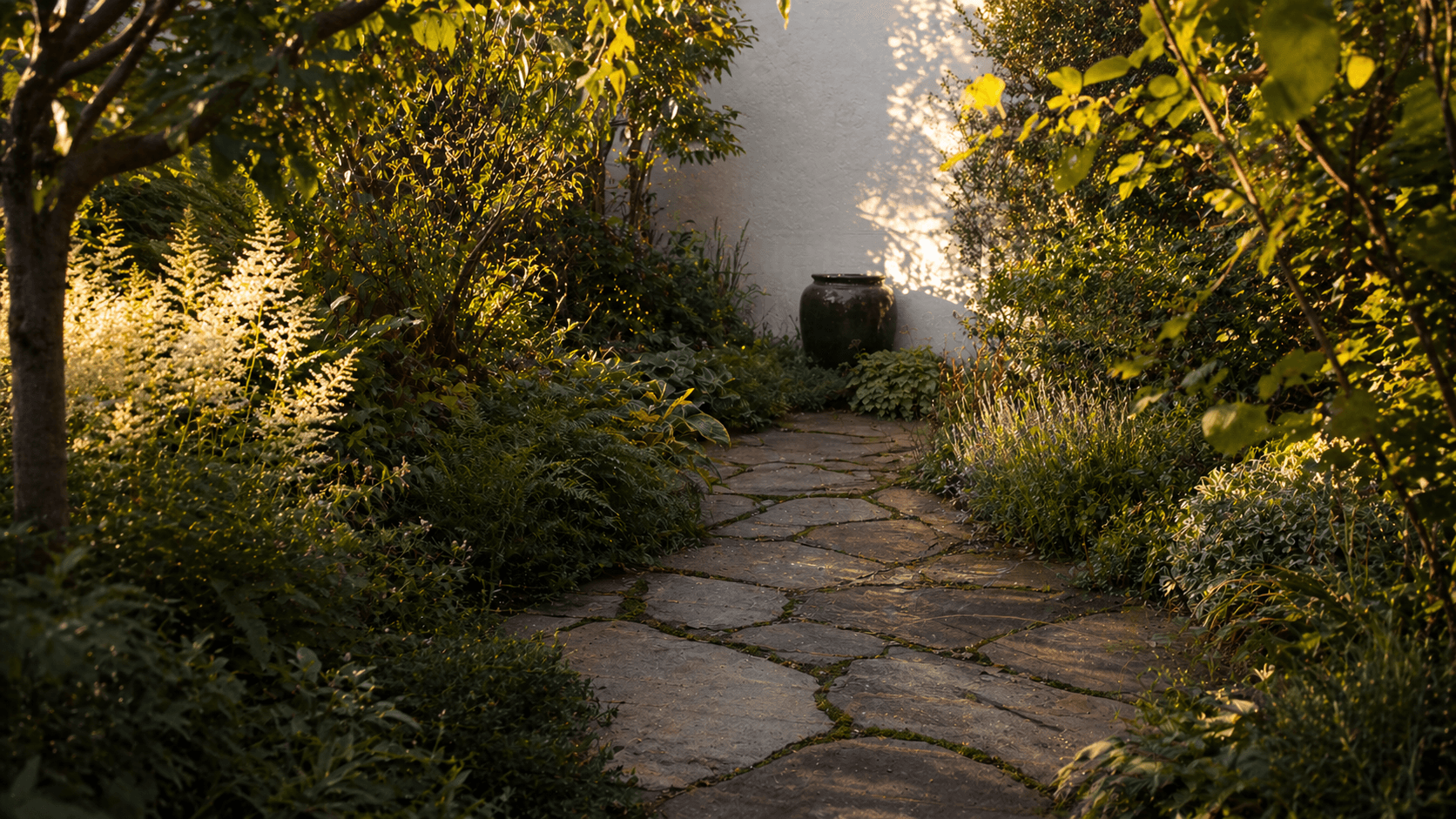
Every garden, however small, benefits from a focal point — something that draws the eye across the space rather than letting it settle on the nearest surface. A well-placed pot, a piece of sculpture, a distinctive plant, even a lantern on a post: the function is to give the eye somewhere to travel, which creates the perception of distance.
The placement of a focal point also determines how the space reads. A focal point centred on the far boundary pulls the eye straight down the middle of the garden, which emphasises its length (or lack of it). A focal point placed off-centre, or at an angle to the main axis, complicates the geometry of the space in a way that makes it feel less immediately legible — and less immediately small.
This is related to a broader principle: diagonal design lines make small spaces feel larger than orthogonal ones. Paving laid at 45 degrees to the house, a path that cuts diagonally across the garden, planting beds that interrupt the rectangular logic of the boundary — each of these introduces a sightline longer than the garden's actual width or length. The eye follows the longer line and the space feels bigger than it is.
The Role of Levels
Changes in level are one of the most powerful tools in a small garden — and one of the most underused, possibly because they involve groundwork and therefore cost. Even a modest shift in height, a raised planting bed or a sunken seating area, introduces a spatial complexity that a flat garden simply cannot achieve. You are experiencing two different places within the same square footage, and that distinction registers psychologically even when the physical difference is only a few hundred millimetres.
Where budget or conditions make level changes impractical, vertical height in planting can do some of the same work. A tall, slim plant — an Acer, a slim columnar evergreen, a climbing rose on a well-placed structure — draws the eye upward and adds a dimension to the space that horizontal planting cannot. Small gardens tend to be designed in two dimensions when three are available.
Restraint in Materials
There is a temptation in small gardens to use multiple materials — different paving types, mixed decking and stone, gravel in the beds, brick edging — in a way that introduces variety. What we've found is that this tends to work against the sense of space rather than adding to it. Multiple materials create multiple visual stopping points, which chop the space into smaller pieces.
A limited material palette — ideally one primary surface material, used consistently — gives the eye permission to travel over the floor plane without interruption. It makes the garden feel cohesive, calm, and larger. Any variation introduced should have a clear purpose: a change in material that signals a change in use, for example.
The same applies to planting. A small garden planted with twenty different species in small quantities looks busy and reads as small. A small garden planted with fewer species in larger groupings looks considered and reads as generous. Repetition of the same plant at intervals through a border creates rhythm and pulls the eye along rather than stopping it. For a shortlist of the perennials and shrubs we've consistently found work well in temperate small-garden plantings, see our note on plants that earn their keep.
Light and Reflection
Light — both natural and designed — changes the perceived scale of a space. A garden that receives good light for part of the day will always feel more open than a shaded one of the same size, and there is relatively little to be done about that beyond choosing the right plants for the conditions.
What can be managed is how the garden handles the light it does receive. Pale or reflective surfaces — light-coloured paving, white or cream rendered walls, glossy-leaved evergreens — bounce light around the space and prevent the heaviness that darker materials create. Water, even in a small form, reflects the sky and introduces movement and depth.
Mirrors used in garden design are a well-worn trick, but they work. A mirror placed on a boundary wall behind planting reads as a window into a further garden, particularly when the reflection is broken up by the plants in front of it. The effect is most convincing when the mirror is not immediately identifiable as one.
The Principle Underneath All of This
What connects all of these approaches is the same idea: a small garden feels small when its limits are immediately legible. Every design decision that makes the space harder to read in one glance, layered planting, off-centre focal points, diagonal lines, level changes, restrained palettes, adds complexity that the eye and mind interpret as space.
You are not fooling anyone in a literal sense. But perception of space is genuinely subjective, and the conditions that create a feeling of generosity in a garden are well understood. The garden does not need to be bigger. It needs to be designed in a way that makes its size feel beside the point. For a more Ireland-specific take on the same problem, our small Irish garden design guide walks through the climate quirks and material choices that shift the calculation.
Related Notes
- How to Design a Small Garden That Actually Works All Year
- Where Do You Actually Begin? A Practical Framework for Garden Redesign
- Landscape Paralysis: Why You Want a Beautiful Garden and Still Haven't Started
- Plants That Earn Their Keep in a Temperate Garden
- Cheap Garden Ideas That Don't Look Cheap
Small gardens reward design decisions more than any other size. Dedrab takes a photo of yours and returns a layout that uses every square metre on purpose. Try it at dedrab.com.