
DIY Garden Makeover Plan: A Realistic Weekend-by-Weekend Guide
On this page
- Before the First Weekend: The Plan
- Weekend One: Clear, Don't Dig
- Weekend Two: Fix the Bones
- Weekend Three: Hardscape, Part One
- Weekend Four: Hardscape, Part Two
- Weekend Five: Bed Preparation
- Weekend Six: Plant in the Right Order
- Weekend Seven: Lawn and Final Surfaces
- What Comes After: The Establishment Year
- The Honest Total
- Related Notes
There is a particular kind of garden renovation that starts with the very best intentions and stalls three weekends in. The grass has been lifted, the bed has been dug out, half a fence has been replaced, and the rest of the garden is now visibly worse than it was before any work began. The homeowner has lost the thread. The next free weekend is two weeks away. By the time it arrives, the motivation has gone.
A lot of DIY garden makeovers fail this way, and almost always for the same reason: no proper plan, attempted in the wrong order, with no realistic sense of how long each stage takes. The work itself is rarely the problem. The sequencing is.
What follows is a more honest version. A phased plan for a homeowner doing a meaningful garden renovation themselves, over a series of weekends, with the order that actually works and a realistic estimate of what each phase involves.
Before the First Weekend: The Plan
Nothing on this list works without a plan. Not a vague intention. A document, even a rough one, that specifies what the finished garden looks like, what materials it uses, and what plants go where.
The plan can come from a garden designer, from a thorough afternoon of sketching, or from a planning tool. What matters is that it exists on paper before any work begins. That's so Gemma's account of her DIY garden starts with a hand-drawn floor plan of how the garden should look at the end, drawn to scale, used to experiment with layouts before any costly mistakes were made. That is the right starting point. Without it, every weekend is an improvisation. If you're not sure how to start the planning process at all, our note on where to begin with a garden redesign walks through the anchor-zone framework we use first.
The plan needs to cover: the layout (zones for sitting, planting, lawn, storage, anything else), the materials (paving, fencing, decking, edging), the planting (species, quantities, positions), and the phasing (which weekend does what). The phasing is the part most DIY plans skip, and it is the part that determines whether the project actually finishes.
Weekend One: Clear, Don't Dig
The first weekend's job is almost entirely demolition and clearance. Removing what is going. Stripping out tired planting that is being replaced. Pulling up old paving slabs. Taking down any fencing that needs to come out. Cutting back overgrowth to ground level. Bagging it all.
Woodford Recycling notes that clearance is the first and most underestimated stage of a garden renovation: removing worn furniture, structures, stones, weeds, and damaged grass before anything new starts. A skip is genuinely useful here for a meaningful renovation. The hire cost is small compared to the time saved on multiple tip runs.
The temptation on this weekend is to start digging beds for the new layout. Resist it. The site is still too cluttered to think clearly, and digging now means moving the soil at least once more before the bed is finished. Clear first. Visualise the cleared site against the plan. Make any adjustments to the plan based on what is now obvious that was not before. Then stop.
The honest time estimate for clearance on a typical residential garden is one to two full days. Two people working steadily can clear most suburban gardens in a weekend.
Weekend Two: Fix the Bones
Once the site is clear, the structural elements come next. Drainage if it is a problem. Levelling if the ground is unworkable. Boundaries (fences, walls, hedge replacement) that are part of the new design.
This is the most physical weekend of the project. Fencing in particular is hard work even for two people, especially if old concrete posts are coming out. A post puller hire saves the back and is worth the £40. Setting new posts in concrete needs 24 to 48 hours to cure before any rails or panels go on, so plan the work across the weekend with that in mind.
Drainage problems, if they exist, are addressed here. A French drain across a wet area, a soakaway in the lowest corner, or a surface gradient adjusted with topsoil. Skipping drainage at this stage means a paved area that floods or a planted bed that drowns its plants in winter. Both are expensive to fix later.
Honest time estimate: one weekend for a typical project. Two if the boundaries are substantial or the drainage is significant.
Weekend Three: Hardscape, Part One
Paths first. Patio next. Any large hard surfaces that the rest of the garden flows around. This weekend is the one where the new shape of the garden starts to become visible, which is a good morale boost after two weekends of clearance and digging.
Small patios and paths are within reach of a competent DIY homeowner. Gardeners' World notes that a garden patio can be laid in as little as a weekend, with proper preparation. The honest version is "a weekend for a small patio, two weekends for a larger one, and only attempt it if the ground prep is done properly."
The critical thing is the base. A paving project that goes wrong almost always goes wrong because the sub-base was inadequate. Compacted hardcore (Type 1 MOT) to a depth of at least 100mm, levelled and tamped, is the foundation under any patio. Skipping the base saves nothing in time and creates a patio that sinks within a year.
If the project includes anything more ambitious in hard landscaping (retaining walls of any significant height, complex changes of level, large decks), it is worth being honest with oneself about whether DIY is the right call. The work is physical, the materials are heavy, and the consequences of getting it wrong are expensive. Bringing in a landscaper for the hardscaping while keeping the planting as DIY is a sensible split that a lot of successful self-implementers use, and our note on hard landscaping vs soft landscaping covers why the structural work needs to come first regardless of who does it. For a fuller view of where the money typically goes in a project at this scale, see our garden design cost breakdown for 2026.
Weekend Four: Hardscape, Part Two
Smaller hard elements. Raised beds. Edging. Steps if there are any. Anything that defines the boundaries of the planted areas. A railway-sleeper raised bed or a breeze-block bed clad in timber takes a day to build properly, and creating the bed footprint now (rather than after planting) makes the planting weekend dramatically easier.
This is also the weekend for any structures: a pergola, a small shed reposition, a feature like a brick barbecue or a fire pit. Wood structures benefit from being built in dry weather and given a coat of preservative before they go up. Concrete elements need a 48-hour cure window before they are loaded.
Honest time estimate: one to two weekends depending on how many small structural elements the design includes.
Weekend Five: Bed Preparation
This is the stage that determines how well the planting establishes, and it is the stage most DIY makeovers shortcut. Plants put into unprepared ground will struggle for two years and a noticeable percentage of them will fail.
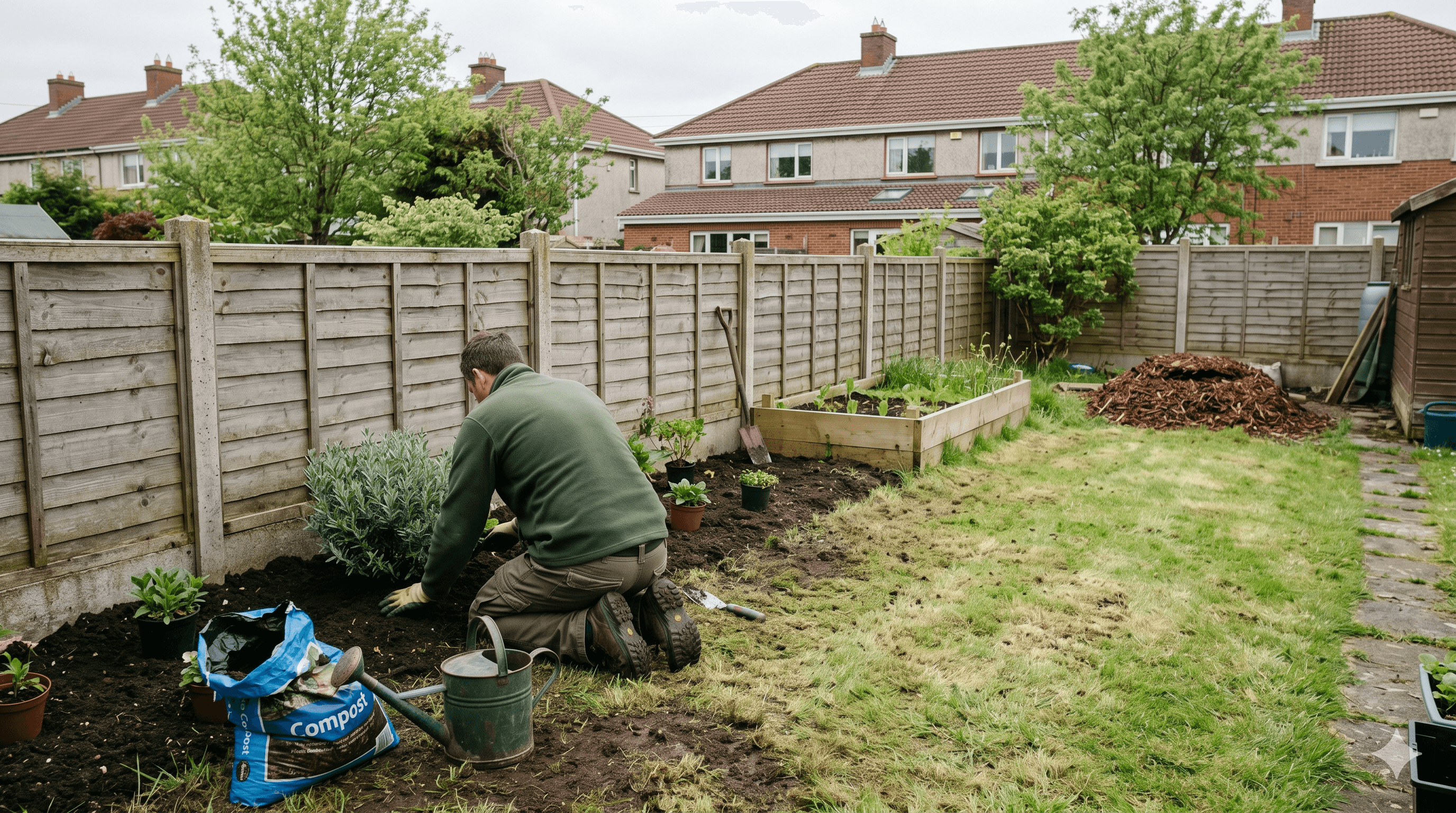
Bed preparation involves: clearing the bed of weeds and roots, working in 50 to 100mm of good-quality compost or well-rotted manure, breaking up any compacted soil, and checking drainage one more time. For clay soils, the compost addition makes a particularly significant difference to long-term plant health.
A homeowner who has not done this before tends to underestimate how much compost a bed actually needs. A 10 square metre bed needs roughly 0.5 to 1 cubic metre of compost worked in. A few bags from the garden centre will not cover it. Bulk delivery from a local supplier is dramatically cheaper per cubic metre and worth the call.
Honest time estimate: one weekend for the planted areas in a typical residential garden. Two if the soil is particularly poor.
Weekend Six: Plant in the Right Order
The order of planting matters more than most homeowners realise. Trees and large shrubs first, because they anchor the scheme and need to be sited properly relative to the rest of the design. Then smaller shrubs and the structural perennials. Then the smaller perennials, groundcovers, and bulbs.
This order matters because trees and shrubs cast shade and define the proportions of the bed. Planting a delicate perennial in a spot that turns out to be in the deep shade of a future shrub is a small annoyance now and a dead plant in two years.
Watering at planting matters more than most homeowners realise. Every plant goes in with a proper soak: roughly a watering can per shrub, half that per perennial. The water settles the soil around the roots and is the single biggest factor in establishment. A plant put in dry, especially in spring or summer, may not recover.
Mulch goes on after planting, not before. A 75 to 100mm layer of bark mulch over the bed suppresses weeds, retains moisture, and dramatically reduces the workload over the next 12 months. This is the recommendation that appears in every gardening article because it is the one that actually works.
Honest time estimate: one weekend for the planting of a typical residential scheme. Two if the planting list is particularly extensive.
Weekend Seven: Lawn and Final Surfaces
Lawn last, because it is vulnerable to construction traffic and would be destroyed by any work happening on the surrounding beds. New turf goes down on a properly prepared base (rake the soil level, remove stones, add a thin layer of topsoil if needed) and is watered daily for the first two weeks. Seed is dramatically cheaper but takes a full season to establish and is fragile during that time.
If the design uses gravel rather than lawn (a sensible low-maintenance choice in a lot of climates), the gravel goes down now over a weed membrane, with a clean edge to the planted beds. Compacted properly, it takes very little ongoing care.
Anything that has been deferred (lighting, irrigation timer, furniture, the small fiddly finishing tasks) goes in this weekend or the one after. The garden is functionally complete at this stage.
What Comes After: The Establishment Year
The makeover is built. The first year is what determines whether it succeeds. Watering through the first growing season, especially during dry spells, is non-negotiable. New trees and shrubs need a soak once a week at minimum until they are properly established. A drip irrigation system on a timer is the most reliable solution and worth the £200 to £600 install cost. A weekly walk-through with a hose works too.
Weeding stays on top of in year one. Once the planting closes in and the mulch is doing its job, weeding becomes minimal. Until then, a quick pass once a week stops anything establishing.
Mulch tops up once a year, ideally in late autumn or early spring. Lawn (if there is one) gets a feed and an aeration in autumn. None of these is dramatic but skipping them is the difference between a garden that gets better over time and one that quietly gets worse.
The Honest Total
A meaningful DIY garden renovation, done properly, takes six to eight weekends spread across a season. It is hard work. It is also, for a lot of homeowners, more satisfying than handing the work over entirely, and it costs roughly half of what the same project would cost contracted out.
The version that fails is the one without a plan, attempted in the wrong order, on weekends that drift further apart as motivation fades. The version that succeeds is the one with a plan, sequenced properly, with each weekend's work understood before it starts. That is the entire difference.
Related Notes
- Designing a Garden You Can Actually Maintain in Under an Hour a Week
- Where Do You Actually Begin? A Practical Framework for Garden Redesign
- Landscape Paralysis: Why You Want a Beautiful Garden and Still Haven't Started
- Hard Ground, Soft Touch: Understanding What Your Garden Is Actually Made Of
- Garden Design Cost Breakdown 2026: What a Garden Renovation Actually Costs
- DIY or Hire a Landscaper? How to Actually Decide
The first step to a DIY garden makeover that actually finishes is the plan that every weekend follows. Dedrab produces a Garden Action Plan from a single photo of the space, with the planting list, materials, phasing, and weekend-by-weekend sequence laid out, so the work starts with a real plan instead of an optimistic Saturday morning. Begin at dedrab.com.
References
- That's so Gemma, How to Plan & Complete a Garden Renovation
- Woodford Recycling, Garden Renovation: Your Step-by-Step Guide
- Gardeners' World, 10 garden DIY projects for the weekend
- The Honeycomb Home, 13 Garden Projects You Can Do In A Weekend
- Extra Space Storage, 21 Simple Ideas for Your Home Garden