
Designing a Garden You Can Actually Maintain in Under an Hour a Week
On this page
Every "low maintenance garden" article promises the same thing without ever attaching a number to it. How about this instead: an hour a week. That's the dream, and it's what we're aiming for in this piece, on average across the year. Not every week, mind you, and we'll get to what that actually means, but it's a real budget you can manage, not a restructure of your life.
This isn't a plant list. It's a way of looking at a garden as a set of ongoing time costs, and then making the design decisions that shrink those costs before the plants go in the ground. Get the structure right and the hour a week is achievable. Get it wrong, and there goes your Saturday.
What an Hour a Week Actually Buys You
To be upfront about it: an hour a week doesn't mean the garden looks after itself from day one. It means a garden that, once established (a phrase doing real work here, usually 12 to 18 months), needs light attention rather than regular heavy attention. Weeding a mulched bed. Checking pots in a dry spell. A quick deadhead. It is the difference between "gardening" and "garden maintenance," and it's the second one we solve for here.
It also doesn't mean identical hours every week. Real gardens don't work that way, and we'll come back to that further down, because pretending otherwise is exactly the kind of overpromise this piece is trying to avoid.
The Weekly Time Cost of What's Already in Your Garden
Some garden features are expensive in time regardless of how well they're planted. This is the bit most low-maintenance advice skips, because it's more comfortable to talk about plants than to admit that some very normal garden features are the actual problem.
| Feature | Typical weekly time cost | Why |
|---|---|---|
| Lawn, mown weekly in season | 30–60 minutes | Mowing, edging, and the strimming you do around the bits the mower can't reach. Feeding and scarifying add occasional larger sessions on top. |
| Formal clipped hedging (box, yew topiary) | 15–20 minutes averaged | Low most of the year, then a half day twice a season that the weekly average quietly hides. |
| Several small pots | 20–30 minutes | Small pots dry out fast and need checking individually. The RHS puts this plainly: the smaller the pot, the more often it needs water. |
| Bedding schemes, changed twice a year | 20 minutes averaged | Two full replanting sessions a year, spread thin across the calendar, still adds up. |
| Mulched shrub and perennial border | 5–10 minutes | Occasional weeding, an annual tidy. This is the cheapest square metre in the whole garden once it's in. |
| Gravel or paved surface | Under 5 minutes | Occasional sweep or weed of the joints. Close to maintenance-free. |
None of these numbers are precision measurements, they're the kind of honest estimate you get from doing this for a living rather than reading it off a seed packet. But the pattern holds regardless of your specific garden: lawn and small pots are where the hours go, and mulched structural planting is where they don't.
Five Design Choices That Buy Back Your Saturday
Shrink the lawn to a shape, not just a size. A smaller lawn still needs mowing, so the win isn't really about area, it's about awkwardness. A lawn with straight edges and no fiddly corners mows in half the time of one with the same square footage cut into curves around six different beds. What we've found works best is deciding what job the lawn is actually doing (somewhere to put a chair, somewhere for the kids or the dog) and shaping it to do only that.
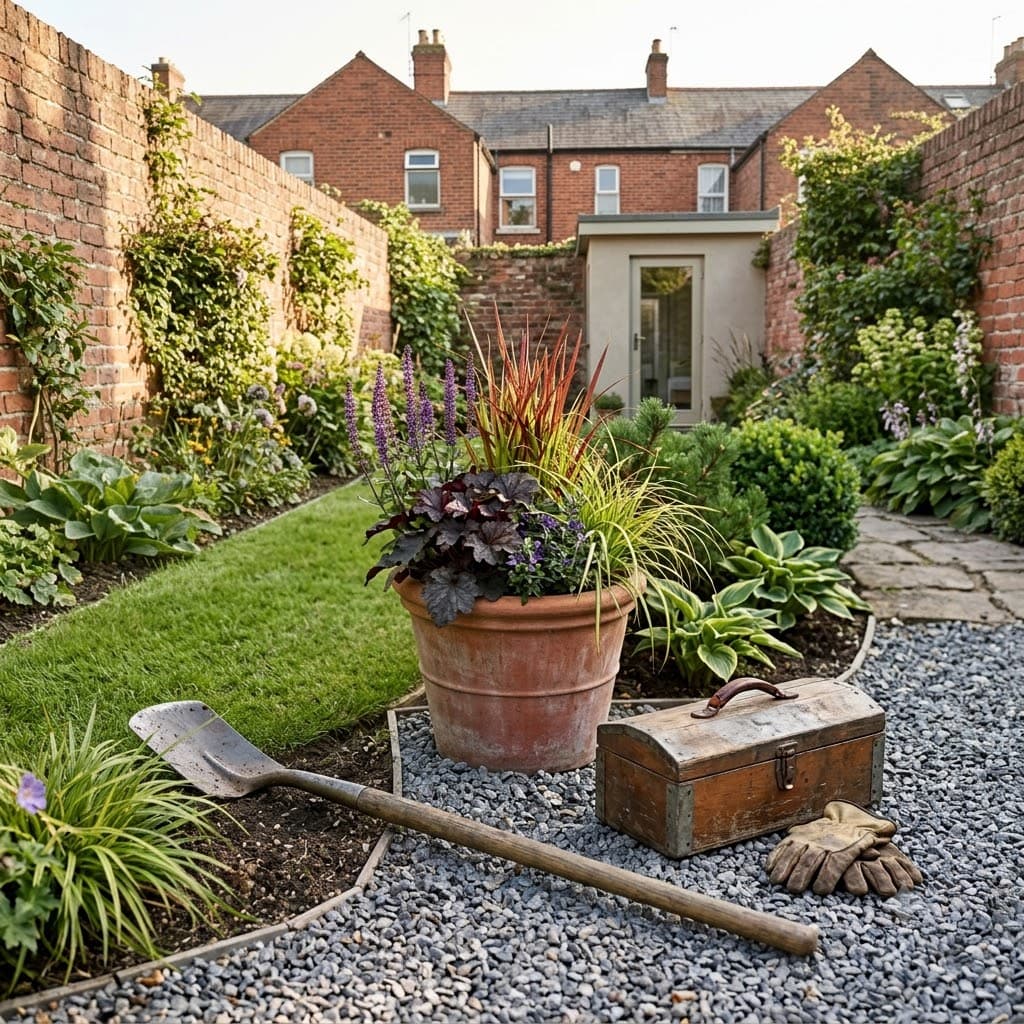
One generous pot arrangement instead of six small ones. This isn't just a look, it's a maintenance decision. A single large container holds moisture for days longer than a small one, and one big pot to check is quicker than six scattered ones to remember. Group three plants of different habits (something upright, something filling, something trailing) into one container and you'll water it less than you watered any single small pot before.
Trade formal shapes for looser structure. Box balls and clipped hedges look sharp, but that sharpness costs two proper sessions a year with shears or a trimmer, plus the ongoing worry about box blight. Loosely clipped or naturally rounded evergreens (viburnum, osmanthus, many hebes) give you the same year-round structure without the twice-yearly appointment with the topiary shears.
Mulch properly, and mean it. A 75 to 100mm layer over bare soil around shrubs and perennials suppresses the weeds that would otherwise be your main weekly job. It's the least glamorous line item in this whole article and also the one that does the most actual work. Skip it and you're weeding by hand every week regardless of what else you get right.
Put pots and new planting on a drip line with a timer. Hand watering is a daily decision that someone has to remember to make, which is exactly the kind of small recurring task that erodes an hour-a-week budget without ever showing up as one big job. An inexpensive drip system on a tap timer removes the decision entirely, and it's doing quiet work even in wetter climates during the establishment period for new planting.
A Realistic Week (and Year) in This Garden
Here's the honest version, because a flat "one hour, every single week" claim would be exactly the kind of overpromise we're trying to avoid.
Most weeks in a garden designed this way run to twenty or thirty minutes: a walk around, a bit of deadheading, checking pots if it's been dry. A handful of weeks in spring and fine again in autumn run longer, an hour or ninety minutes, because that's when growth is doing the most and beds need their seasonal tidy. Then there are two, maybe three sessions a year (the big cutback, the mulch top-up, the hedge trim if you've got one) that run to half a day each and quietly get amortised into the "average" figure.
Add all of that up across fifty-two weeks and it nets out to under an hour a week. It just doesn't arrive in equal weekly instalments, and any article that tells you it does isn't being straight with you.
What Doesn't Fit in an Hour a Week
In the interest of not overselling this: some things will blow the budget regardless of how well the rest of the garden is designed.
A lawn over roughly 80 to 100 square metres, mown weekly, is a real weekly commitment on its own, however you shape the edges. Formal parterres or intensive topiary are a genuine hobby, not a maintenance task, and deserve to be budgeted as one. A productive vegetable patch needs regular attention through the growing season, that's simply what growing food involves, and it's worth doing for its own reasons rather than pretending it's low maintenance. Bedding schemes replanted seasonally, a pond with fish, and anything that needs daily hand watering without an irrigation system will all sit outside this budget too. None of these are wrong choices. They're just different budgets, and it's worth knowing which one you're actually signing up for before you commit to it.
Related Notes
- Low Maintenance Garden Ideas by Climate Zone: What Actually Thrives Where
- How Would I Get My Garden From Drab to Fab?
- DIY Garden Makeover Plan: A Realistic Weekend-by-Weekend Guide
- Plants That Earn Their Keep: What We've Found Thrives in a Temperate Garden
- Surviving a Hosepipe Ban: What Actually Works When You Can't Water the Garden
- Reviving Your Garden After a Hosepipe Ban: What Needs Help and What Doesn't
Frequently Asked Questions
How many hours a week does a low maintenance garden actually need?
Based on what we've found designing gardens this way, an established low-maintenance garden averages under an hour a week across the year, though it doesn't arrive evenly. Most weeks are twenty to thirty minutes, with a few longer seasonal sessions and two or three half-day jobs a year folded into that average.
What's the single biggest thing that adds to garden maintenance time?
Lawn, by a wide margin, followed by several small pots that each need individual watering. Reducing lawn to a genuinely useful shape and consolidating small pots into fewer, larger ones are the two changes that make the biggest difference to weekly time.
Is a low maintenance garden the same as a drought tolerant garden?
Not necessarily. Drought tolerance is one route to low maintenance in dry climates, but the bigger, more universal factor is structure: how much lawn there is, how many small containers need individual attention, and whether beds are mulched. Our climate-by-climate guide covers which plants suit which conditions once the structural choices are sorted.
A garden built around a realistic time budget starts with an honest look at what you've actually got, and what you're actually willing to do each week. That's the first question we ask before any planting goes on a plan. Try it at dedrab.com.
References
- Royal Horticultural Society, Low Maintenance Gardening Ideas
- Royal Horticultural Society, 10 Ways to a Great-Looking, Low Maintenance Garden
- BBC Gardeners' World Magazine, 10 Low Maintenance Garden Ideas