
How Would I Get My Garden From Drab to Fab?
On this page
- 1. The edges have given up
- 2. Everything is happening at one height
- 3. There's no reason for the eye to land anywhere
- 4. Three small pots where there should be one big one
- 5. The lawn is doing all the talking
- 6. The brown stuff nobody loves
- 7. Nowhere to actually sit, away from the back door
- 8. After dark, it disappears completely
- What ties all eight of these together
- Related Notes
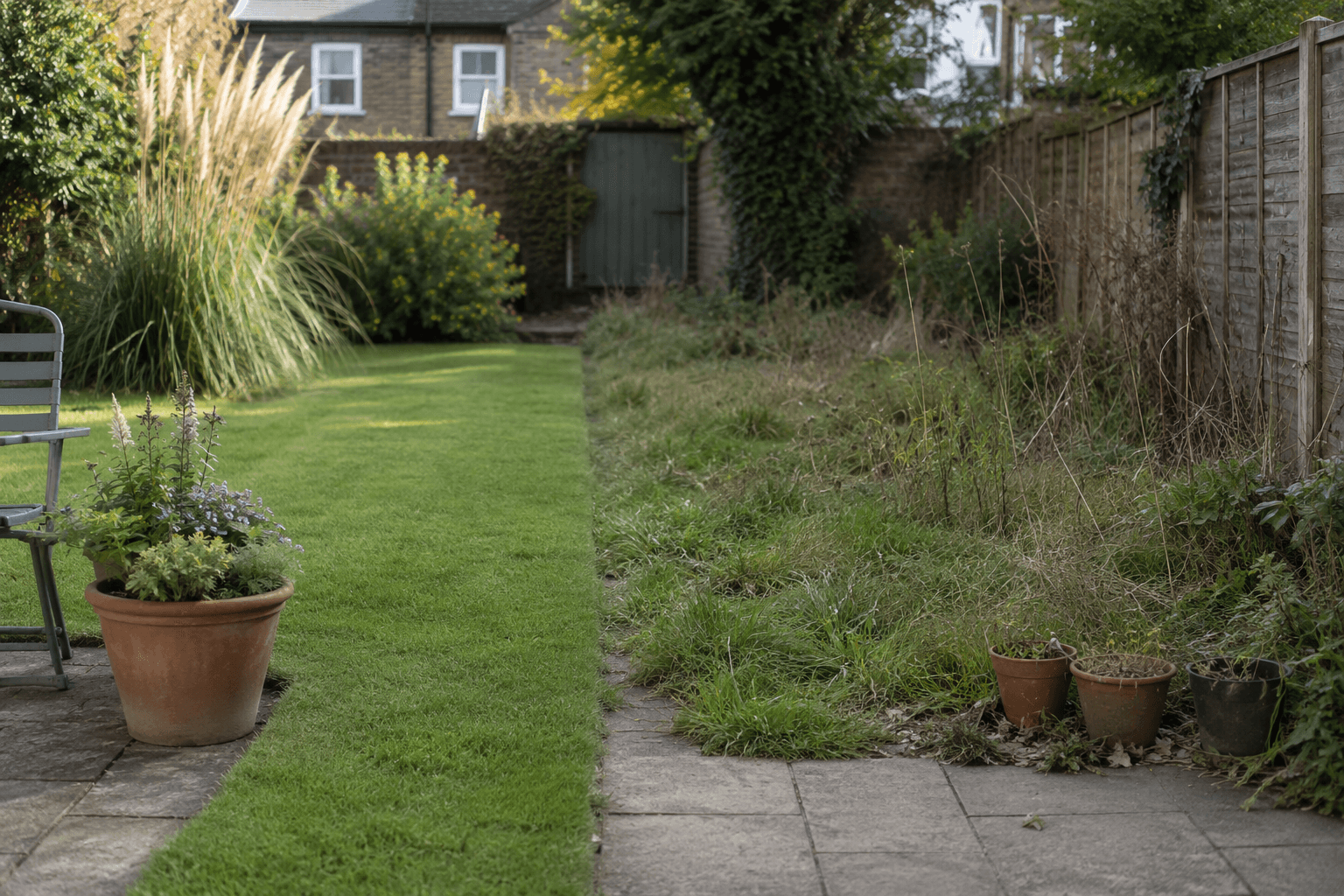
There's a particular flavour of garden that most homeowners know well. It's not ugly. It's not broken. It's just... drab. That scruffy lawn. A dirty old fence and a few pots that have seen better days. Next time you stand at the door, mug in hand thinking that some day you will get around to dealing with the garden, here are eight little keystones of Drab that we see, and what you could do about each one between now and Sunday evening. If the bigger problem is that you don't know where to start at all, we've written about that elsewhere in our note on landscape paralysis.
1. The edges have given up
Walk out and look at where your lawn meets the border. If the line is fuzzy, scalloped, or has quietly migrated into the planting, that single detail is doing more to make the garden feel scruffy than anything else.
What we've found: a sharp, deliberate edge is the cheapest visual upgrade in gardening. Half an hour with a half-moon edger or a flat spade, walking the boundary and recutting a clean line, will lift the entire space. The plants haven't changed. The lawn hasn't changed. The garden has.
2. Everything is happening at one height
Drab gardens almost always have a height problem. There's a flat lawn, a low border, and then the fence — and nothing is happening between knee height and head height. The eye has nowhere to rest, so the whole garden reads as flat.
The weekend fix is rarely a redesign. It's adding one mid-height thing. A tall ornamental grass. A bamboo cane tripod with sweet peas or a clematis. A repurposed tomato cage with a climbing nasturtium. Pick a spot the eye naturally lands on, and put something there that's between two and five feet tall.
3. There's no reason for the eye to land anywhere
Step outside and ask yourself: where is my eye supposed to go? If the answer is "I don't know," that's the issue. Drab gardens are democratic — every part of them is asking for the same amount of attention, which means none of it gets any.
What we've found works is giving the eye one clear destination. A single large pot at the end of a path. A weathered chair tucked into a corner. A salvaged stone or a piece of driftwood placed with intent. It doesn't need to be expensive. It needs to look like someone meant it to be there.
4. Three small pots where there should be one big one
Most front and back doors we visit have the same arrangement: three or four small terracotta pots, each with one tired plant, looking apologetic. The instinct to add more pots is the right one. The execution is the problem.
Swap them for a single generous container. One large pot, three plants in it — something tall, something filling, something trailing — and that's it. It looks intentional. It needs less watering. And it does in one corner what four scattered pots fail to do across the whole step.
5. The lawn is doing all the talking
If two-thirds of your garden is grass, the grass is the design. And grass, on its own, has very little to say. It's a backdrop. Backdrops shouldn't be the main feature.
A weekend move that we've found pays off enormously: carve a curve out of the lawn. A gentle sweep, taken from one side, mulched well, and planted with three or four hardy perennials and a grass or two for movement. You're not redesigning the garden. You're stealing back ten square metres of it and giving it something to do.
6. The brown stuff nobody loves
Every drab garden has at least one. A faded fence panel. A patch of decking that's gone grey and slippery. A dead conifer in a corner that everyone has been pretending isn't there. These items are visual dead weight, and they drag the whole garden down with them.
The trick this weekend isn't to replace anything — replacement is expensive and slow. It's to remove or refresh. Jet-wash the decking. Paint the fence in a darker, recessive shade so it disappears behind the planting. Saw out the dead conifer entirely and leave the gap. An empty corner reads better than a sad one.
7. Nowhere to actually sit, away from the back door
A surprising number of gardens have only one seating option, and it's the table directly outside the kitchen. Which means most of the garden never gets used, or even properly looked at, because nobody walks down to it.
The weekend test is simple. Take a single chair — any chair, even an old wooden one from the shed — and put it in the part of the garden you almost never visit. The far corner. The bit behind the shed. The patch of grass that gets the late evening sun. That's it. Don't build a patio for it. Just put the chair there. What we've found is that the moment a garden has a destination, it stops being a view and starts being a place.
8. After dark, it disappears completely
Most gardens cease to exist at dusk. Which is a particular shame in spring and summer, when the best hours to be in them are between seven and ten in the evening.
You don't need a lighting scheme. You need to light one thing. A single solar uplighter at the base of a tree. A line of three lanterns along a path. A festoon string above the seating area. The aim isn't to flood the garden — it's to give it something to look like after the sun has gone. One well-chosen light does more than ten cheap ones flung about the place.
What ties all eight of these together
Notice what isn't on the list. There is no "rip out the patio." No "install a water feature." No "rebuild the borders from scratch." Every one of these is a small, reversible, weekend-scale move that costs less than a takeaway and changes how the garden feels the moment you step outside.
What we've found, over and over, is that drab gardens are almost never suffering from a lack of money or a lack of plants. They're suffering from a lack of decisions. Eight small ones, made on a Saturday morning, will get most gardens a long way down the road from drab toward something that actually feels yours.
If you want to go further than the weekend will allow, to see what your garden could actually look like with a proper redesign behind it, the button at the top of the page is where to start. Upload a photo, pick a style, and have a look. No commitment, no spreadsheet, just a way to see it before you commit to anything bigger.
Related Notes
- Designing a Garden You Can Actually Maintain in Under an Hour a Week
- Landscape Paralysis: Why You Want a Beautiful Garden and Still Haven't Started
- Where Do You Actually Begin? A Practical Framework for Garden Redesign
- DIY Garden Makeover Plan: A Realistic Weekend-by-Weekend Guide
- Making Small Gardens Feel Generous: Design Principles That Actually Work
- What Would My Garden Actually Look Like? Seeing Before You Spend
If the weekend wins above whet your appetite for something bigger, dedrab will turn a single photo of your garden into a full action plan, planting and all. Try it at dedrab.com.