
Low Maintenance Garden Ideas by Climate Zone: What Actually Thrives Where
On this page
"Low maintenance" is one of the most overused phrases in garden design, and one of the most badly defined. It is sometimes used to mean drought-tolerant. Sometimes to mean evergreen. Sometimes to mean "no lawn." Occasionally to mean "I want this to look effortlessly wild but actually require zero effort," which is the gardening equivalent of wanting abs without sit-ups.
The honest definition is narrower than any of those. A low-maintenance garden is one designed so that every element, from the layout to the planting to the materials, reduces ongoing labour. That definition depends almost entirely on climate, because what counts as low-maintenance in Cornwall is high-maintenance in Phoenix and impossible in Perth. So instead of a single list of "low maintenance plants," this is a more honest walkthrough of what genuinely works where.
The Three Universal Principles
Before any climate-specific advice, there are three principles that apply everywhere. They are unglamorous, but they do more for ongoing workload than any plant choice.
The first is to reduce lawn. Turf is the single highest-maintenance element in most residential gardens, demanding mowing, edging, feeding, and watering for nine months of the year in temperate climates and pretty much all year in warmer ones. Replacing lawn with planted beds, gravel, paving, or groundcover is the fastest possible way to cut workload. Designscapes in Australia argues that reducing lawn is the single biggest lever for cutting upkeep, and that paragraph applies almost verbatim regardless of country.
The second is to plant for the climate. A plant that is fighting its environment will demand water, feeding, and replacement. A plant that is genuinely suited to the local rainfall, temperature, and soil will, after its establishment period, look after itself. This is the entire argument for native and climate-adapted planting, and it is the difference between a garden that thrives and one that simply survives.
The third is mulch. A 75 to 100mm layer of mulch over planted areas suppresses weeds, retains moisture, and reduces both watering and weeding by a significant margin. It is the least interesting recommendation in any garden article, and it is also the most reliably effective.
With those three baselines in place, the rest is climate. If you'd rather start from a weekly time budget than a climate zone, we've broken that down separately in designing a garden you can maintain in under an hour a week.
UK and Ireland: Maritime Climate, Hardiness Zones 7–9
The UK and Ireland sit in European hardiness zones 8 to 9, thanks to the warming influence of the Atlantic. That means mild winters by international standards, cool summers, and consistent rainfall through most of the year. The challenge is not heat or drought. It is wet winters, occasional summer dry spells, and the fact that "consistent rainfall" turns out to mean "intermittent floods, then a six-week dry patch in July." If you're new to the hardiness system at all, our beginner's guide to plant hardiness covers the H1–H7 scale and how to read your specific microclimate.
The low-maintenance planting palette for this climate leans into structure and resilience. Evergreen shrubs do the heavy lifting: box, yew, viburnum, holly, sarcococca. They hold the bones of the garden through winter and require little more than an annual prune. Ornamental grasses such as deschampsia, calamagrostis, and miscanthus add movement and seasonal interest while needing only one tidy-up in late winter.
Hortus Pink Landscapes notes that 2026 UK garden design is moving towards drought-to-flood-tolerant planting, with deep-rooted perennials that handle both ends of the spectrum. Plants like sedum, salvia, geranium, and astrantia perform well across wet and dry conditions once established. The "once established" caveat is doing a lot of work in that sentence: most perennials need 12 to 18 months of attentive watering before they are genuinely self-sufficient. After that, they are.
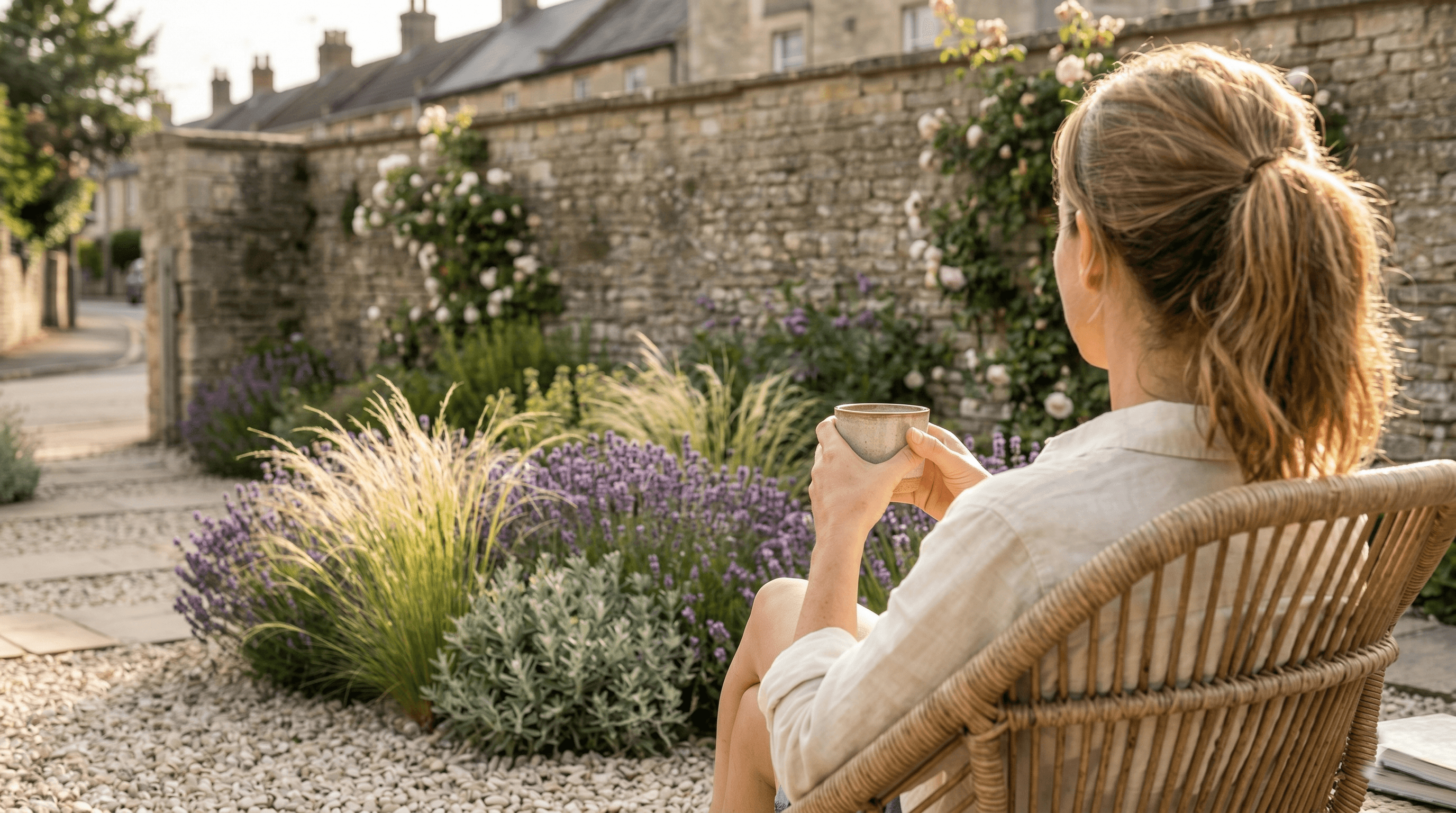
What does not work in this climate, despite frequent recommendation, is anything Mediterranean planted in heavy clay. Lavender, rosemary, and olive trees can survive in UK and Irish gardens, but they need raised beds with sharp drainage. Planted into typical garden clay, they sulk for two years and die. A homeowner wanting a "Mediterranean look" is usually better off mimicking the structure (gravel, evergreen mounds, silver foliage) using plants that actually like wet winters, such as santolina, perovskia in a sheltered spot, or hebes for the evergreen mound role.
For surfaces, gravel is the dark horse of low-maintenance materials in this climate. It drains well, requires no maintenance beyond occasional weeding (which a mulch membrane underneath largely eliminates), and creates the visual texture that turf does, without the workload.
United States: Eight Climate Zones, Three Practical Categories
The US spans USDA hardiness zones 1 to 13, which is to say "everything." A low-maintenance garden in Minneapolis (zone 4) looks nothing like a low-maintenance garden in Miami (zone 11) or Phoenix (zone 9b but desert, which the zone alone does not capture). For practical purposes, three categories cover most US residential gardens.
Cool and continental climates (zones 3 to 6). Long, cold winters, hot summers, and a relatively short growing season. The low-maintenance approach here leans on hardy perennials and shrubs that can take a frozen winter without complaint. Hostas, daylilies, sedum, ornamental grasses such as little bluestem and switchgrass, and native shrubs like serviceberry and viburnum form the backbone. Mulched beds, gravel walkways, and reduced lawn footprints are particularly effective because they reduce the spring cleanup window that defines garden labour in these zones.
Temperate and humid subtropical climates (zones 7 to 9, eastern US). Hot, humid summers and mild winters. Native planting genuinely outperforms imported ornamentals here, both in workload and in resilience. Coneflower, black-eyed Susan, switchgrass, native viburnums, and oakleaf hydrangea require little intervention once established. Mulch is non-negotiable because of weed pressure in warm humid conditions.
Arid and Mediterranean climates (zones 8 to 11, western US). This is where xeriscaping (designing for low or no irrigation) genuinely transforms the workload. Drought-tolerant plants, gravel and decomposed granite surfaces, and the deliberate elimination of lawn make for gardens that look intentional and require almost no water once established. HomeGuide notes that xeriscaping is now treated as a distinct cost category in US landscaping, separate from hardscape and softscape, reflecting how mainstream it has become in southwestern states.
Across all three categories, the same principle holds: native or naturalised plants do far less work than imported ornamentals, and a homeowner buying plants from a local nursery rather than ordering online will end up with stock that has been selected for what actually thrives nearby.
Australia: Six Regions, Wildly Different Realities
Australia covers hardiness zones 2 to 5 in the Australian system (roughly USDA 7b to 11), but zone is even less useful here than elsewhere, because the country contains arid desert, cool mountain, sub-tropical, temperate, and Mediterranean climates within its borders. The good news is that Australian native plants are some of the most genuinely low-maintenance options available anywhere in the world, once climate-matched.
Inspiring Landscapes notes that 2026 garden design in Australia is leaning heavily into climate-responsive planting, with native species replacing high-water imports across the country. The standout performers are similar to the recommendations from Designscapes: westringia, lomandra, grevillea, dianella, and coastal banksia, all of which handle heat, wind, and variable rainfall without intensive feeding or watering.
For coastal Australian gardens (Sydney, Brisbane, Perth coastal), the wind and salt are the dominant challenges. Coastal banksia, pigface groundcovers, and hardy ornamental grasses are reliable, and soil amended with organic matter before planting strengthens root systems against the conditions.
For inland and arid regions, the planting list shifts towards more drought-extreme species: agave, kangaroo paw, succulents, and architectural natives like xanthorrhoea. Hardscape carries more of the garden in these regions because planted areas are necessarily restrained.
For temperate Australian gardens (Melbourne, Adelaide, parts of NSW), the palette widens considerably and Mediterranean planting (lavender, rosemary, olive) genuinely works well in well-drained soil, which is a happier story than the UK and Irish version of the same plants.
The structural moves are the same as everywhere else: reduce lawn, mulch heavily, automate irrigation with drip systems on a timer, and let the plants do the visual work. A garden designed this way in any Australian region can drop to two controlled trims a year and seasonal mulch top-ups, with no weekly workload at all.
What Stays the Same Everywhere
Across all of these climates, the same structural decisions show up. Reduced lawn. Mulched beds. Climate-appropriate planting. Drip irrigation on a timer (essential in dry climates, useful even in wet ones for the establishment period). Generous hard surfaces in the areas that take the most foot traffic. Grouped plants by water and light requirements rather than scattered across the bed.
What does not transfer between climates is the plant list. A garden designed for Phoenix will not survive a winter in Dublin, and a garden designed for the Cotswolds will look ridiculous in Brisbane within a month. The frustration with most "low maintenance plant" lists is that they treat the plant as the answer, when the plant is actually the consequence of the climate, the soil, and the way the bed has been prepared. Get those right and the plant choices follow naturally.
The Honest Test of a Low-Maintenance Garden
A truly low-maintenance garden looks good in February as well as in June. It does not require a Saturday's work to recover from a busy week. It does not depend on the homeowner being home to water it. And it gets better over time rather than worse, because the plants are growing into the design rather than fighting it.
That outcome is achievable in any climate. It does not require less ambition. It does not require a smaller budget. What it requires is a plan that takes the local climate seriously, specifies the right plants for that climate, and stops trying to force a Pinterest image from a different hemisphere into the wrong soil.
Related Notes
- Designing a Garden You Can Actually Maintain in Under an Hour a Week
- Plant Hardiness in Ireland: A Beginner's Guide to What the Ratings Actually Mean
- Plants That Earn Their Keep in a Temperate Garden
- What Do the Symbols on Your Plant Label Actually Mean?
- RHS Hardiness vs USDA Zones: A Quick Translator for British, Irish and American Gardeners
- Surviving a Hosepipe Ban: What Actually Works When You Can't Water the Garden
- Reviving Your Garden After a Hosepipe Ban: What Needs Help and What Doesn't
- What Will Grow in a North-Facing Garden?
The first step to a garden that genuinely looks after itself is a plan built around the actual conditions on site, not a generic plant list pulled off the internet. Dedrab produces a Garden Action Plan from a single photo of the space, with planting, materials, phasing and costs specified for the climate the garden is in, not the one in the magazine. Begin at dedrab.com.
References
- Gardenia, Hardiness Zones in Europe
- Hortus Pink Landscapes, Latest UK Garden Design Trends in 2026
- HomeGuide, How Much Does Landscaping Cost? (2026)
- Wikipedia, Hardiness zone
- Australian National Botanic Gardens, Plant Hardiness Zones for Australia
- Inspiring Landscapes, Landscape Garden Trends for 2026 in Australia
- Designscapes, Low Maintenance Garden Ideas Australia 2026 Guide