
What Do RHS Hardiness Ratings Mean? H1 to H7 and USDA Zones
On this page
The rating on a plant label is the coldest winter that plant should survive. Below is what each rating means, where it's safe in the UK and Ireland, and how it translates to USDA zones.
What Does Each RHS Rating Mean?
Each rating is the lowest winter temperature a plant should survive once it's established. Temperature ranges and categories below are the RHS's own.
H1a, H1b and H1c, heated glasshouse
H1a (warmer than 15°C) is a houseplant or glasshouse plant all year. H1b (10 to 15°C) and H1c (5 to 10°C) can go outside for summer in a warm, sheltered spot, then come back under heated glass for winter.
H2, tender
1 to 5°C. It copes with cold but not with being frozen. It needs a frost-free glasshouse in winter everywhere except the mildest inner-city and coastal spots. Roughly USDA zone 10 to 11.
H3, half-hardy
-5 to 1°C. Hardy on the coast and in mild areas except in a hard winter, and at risk from sudden early frosts. Think Cornwall, the Isles of Scilly and the Kerry and Cork coasts; elsewhere give it a south-facing wall or fleece. Roughly USDA zone 9 to 10.
H4, hardy in an average winter
-10 to -5°C. Hardy through most of the UK apart from inland valleys, high ground and central or northern areas, and it may be damaged in a harsh winter. In Ireland it's safe in most coastal and city gardens. Roughly USDA zone 8 to 9. Our Irish county table and UK regional table show where H4 is safe.
H5, hardy in a cold winter
-15 to -10°C. Hardy through most of the UK and Ireland even in a severe winter. Exposed sites and plants in pots are still at risk. Roughly USDA zone 7 to 8.
H6, hardy in a very cold winter
-20 to -15°C. Hardy throughout the UK, Ireland and northern Europe. Plants in containers may still need protection. Roughly USDA zone 6 to 7.
H7, very hardy
Colder than -20°C. Hardy in the severest European continental winters, including exposed upland sites in the UK. Roughly USDA zone 6 or colder.
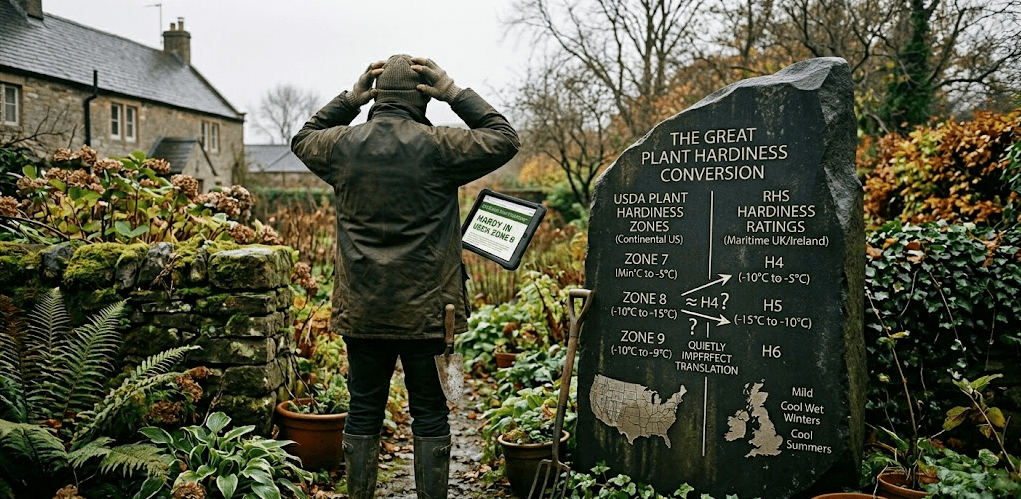
You're looking at a plant in a US online catalogue. It's listed as "hardy in USDA Zone 8." You're in Cork, or Manchester, or Galway, or Bristol, and you have no idea whether that plant will live through your winter or not. The catalogue assumes you know your zone. You don't, because the zone system was designed for someone else's climate.
Same problem in reverse. You're an American gardener moving to London or Dublin, or just reading British gardening books for ideas, and every plant is rated H4 or H5 with no USDA equivalent. The two systems exist in parallel, mostly ignore each other, and the conversion between them is roughly translatable but quietly imperfect in ways that catch people out.
Here's the practical translator, plus the climate quirks that make a direct translation fail more often than it works.
Why Two Systems Exist
The Royal Horticultural Society publishes the RHS hardiness scale, which runs from H1 (frost-free glasshouse only) to H7 (hardy in the most extreme British conditions). It's calibrated against the maritime climate of Ireland and the UK: mild but consistently wet winters, cool damp summers, the moderating influence of the Atlantic.
The United States Department of Agriculture publishes the USDA Plant Hardiness Zone Map, running from Zone 1 (sub-Arctic Alaska) to Zone 13 (Hawaii and parts of Puerto Rico). It's calibrated against average annual minimum temperatures across North America, a continental climate dominated by extremes: hot dry summers in much of the west, cold dry winters in much of the north, humid heat in the southeast.
Both systems answer the same headline question — will this plant survive the cold here? — but they're measuring different climates and were never designed to translate between each other. The conversion table below is approximate, and the section after it explains why the approximation matters.
The Conversion Table
| USDA Zone | Approx. RHS equivalent | Typical North American example | Notes |
|---|---|---|---|
| Zone 5 | H7 | Chicago, Denver, much of New England | Continental winters down to -29 to -23°C |
| Zone 6 | H6 to H7 | Boston, mountain Pacific Northwest | Down to -23 to -18°C |
| Zone 7 | H5 to H6 | Mid-Atlantic states, parts of the south | Down to -18 to -12°C |
| Zone 8 | H4 to H5 | Seattle, lower mid-Atlantic, parts of Texas | Down to -12 to -7°C |
| Zone 9 | H3 to H4 | Coastal California, Gulf Coast, north Florida | Down to -7 to -1°C |
| Zone 10 | H2 to H3 | Southern California, central Florida | Frost-rare to frost-free |
| Zone 11 | H1c to H2 | South Florida, Hawaii | Effectively frost-free |
Most of Ireland and the milder parts of the UK sit somewhere around USDA Zone 8 to 9 in raw winter minimum temperature terms. Most of England is broadly Zone 8. The Scottish Highlands and exposed parts of the Pennines edge toward Zone 7. Western Cork and the Beara peninsula push toward Zone 9.
If you want the full regional breakdown, our UK hardiness guide and our Irish hardiness guide cover it properly, region by region.
Why the Translation Quietly Fails
The conversion table works for raw winter minimum temperature. It misses three other things that, in practice, determine whether a plant lives or dies. This is where the cross-Atlantic confusion starts.
The drainage trap (for US gardeners reading British advice)
A plant rated H5 in the UK can survive a typical Irish or British winter. The problem isn't usually the cold. It's the constant wet. Mediterranean-origin plants — lavender, rosemary, many salvias, certain cistus — are often rated H4 or H5 (good down to around -10°C) but die in Atlantic gardens because the soil is saturated from October through March. The roots rot.
In a USDA Zone 8 garden in California, the same plants thrive because Zone 8 there means dry winters and very dry summers. The hardiness number is identical, the temperature is comparable, but the soil moisture profile is completely different. American gardeners moving to Ireland or the UK and assuming "Zone 8 is Zone 8" learn this the hard way.
The wet-versus-cold paradox (for UK and Irish gardeners ordering from US catalogues)
The mirror problem also bites. A plant listed in a US catalogue as "Zone 8 hardy" was assessed in a climate where Zone 8 means dry winters and hot dry summers. Bring that same plant to an Irish or western British garden and it has to survive the same minimum temperature but in soil that's effectively swampy from autumn through spring. Lots of supposedly "hardy" plants from American catalogues never make it through their first wet winter in Ireland not because of the cold, but because of the cold combined with sustained wet.
Summer heat (for UK and Irish gardeners reading US gardening books)
The USDA system doesn't measure summer heat at all (the American Horticultural Society has a separate Heat Zone Map for that). A plant rated USDA Zone 8 might be fine through the cold but might require a hot dry summer to set flower buds or ripen wood properly. American hybrids bred for the Pacific Northwest or the mid-Atlantic often struggle in Irish or British summers — not because of cold, but because they never get the heat they evolved with.
What we've found is that the most successful cross-Atlantic transplants are plants from comparable climate zones — Pacific Northwest cultivars for western Ireland, mid-Atlantic for eastern England, southern English varieties for the Pacific Northwest — rather than direct zone-number swaps from sun-belt America.
Practical Rules of Thumb
If you're an American gardener moving to Ireland or the UK:
- Most of the country is roughly equivalent to USDA Zone 8 to 9 in temperature, but treat anything rated USDA Zone 9 with caution if it specifies "well-drained" or "drought-tolerant" — that's a warning flag for Atlantic winter conditions.
- Look for plants of British, Irish, Western European or Pacific Northwest origin first. They were bred or selected against conditions closer to what you have now.
- Use the RHS Plant Finder rather than your American catalogues for the first couple of years. The cultural advice is calibrated for your new climate.
If you're a UK or Irish gardener ordering from US sources or reading American gardening books:
- USDA Zone 7 or below means the plant can handle real cold. Almost certainly fine for anywhere in Ireland or the UK. Zone 8 is also probably fine.
- USDA Zone 9 or 10 plants from California or the southwest are likely too tender for most British and Irish gardens, even though the temperature numbers look comparable, because they evolved for hot dry summers and dry winters.
- USDA Zone 9 or 10 plants from the southeast US (Florida, Gulf Coast) handle humidity better but want serious summer heat to perform. Risk-assess accordingly.
And Briefly — Australia and New Zealand
Australia uses its own hardiness scale (zones 1 to 7, where Zone 1 is the coldest alpine and Zone 7 is tropical north), which translates very roughly to USDA Zones 7 through 12. New Zealand mostly maps to USDA Zone 8 to 10 depending on island and elevation. The same drainage and summer-climate caveats apply. If you're working from Australian or New Zealand cultivars, treat them with the same care as American ones: zone is a useful starting point, microclimate is the answer.
The Bigger Point
Hardiness zones tell you whether a plant might survive your average winter. They tell you nothing about whether your specific site will let it thrive. Aspect, soil drainage, exposure to wind, summer moisture, and microclimate within your garden all matter as much as the zone number, sometimes more.
The cross-Atlantic gardener's lesson is the same as the local gardener's: read your site as carefully as you read the label. Zone is the first conversation, not the last. And if reading your own site is the bit you find hard, that's what the plan at the end of this page is for.
Related Notes
- What Planting Zone Is the UK In? RHS H3 to H7 Explained
- Plant Hardiness in Ireland: A Beginner's Guide to What the Ratings Actually Mean
- What Do the Symbols on Your Plant Label Actually Mean?
- Low Maintenance Garden Ideas by Climate Zone
- Your Own Irish Vineyard: How Climate Change Quietly Turned Ireland Into Wine Country
References
- Royal Horticultural Society, RHS Hardiness Ratings
- USDA Agricultural Research Service, Plant Hardiness Zone Map
- American Horticultural Society, Heat Zone Map
- Met Éireann, Ireland's Climate
- Met Office, UK Climate Averages
- Australian National Botanic Gardens, Plant Hardiness Zones for Australia
See It in Your Own Garden
Whatever scale you're working from, the right plant for your garden depends on more than a number. The Dedrab Garden Action Plan starts from a photo of your garden and suggests a redesign and planting plan matched to your climate, soil and aspect, so you can see what works before you spend. Try it at dedrab.com.