
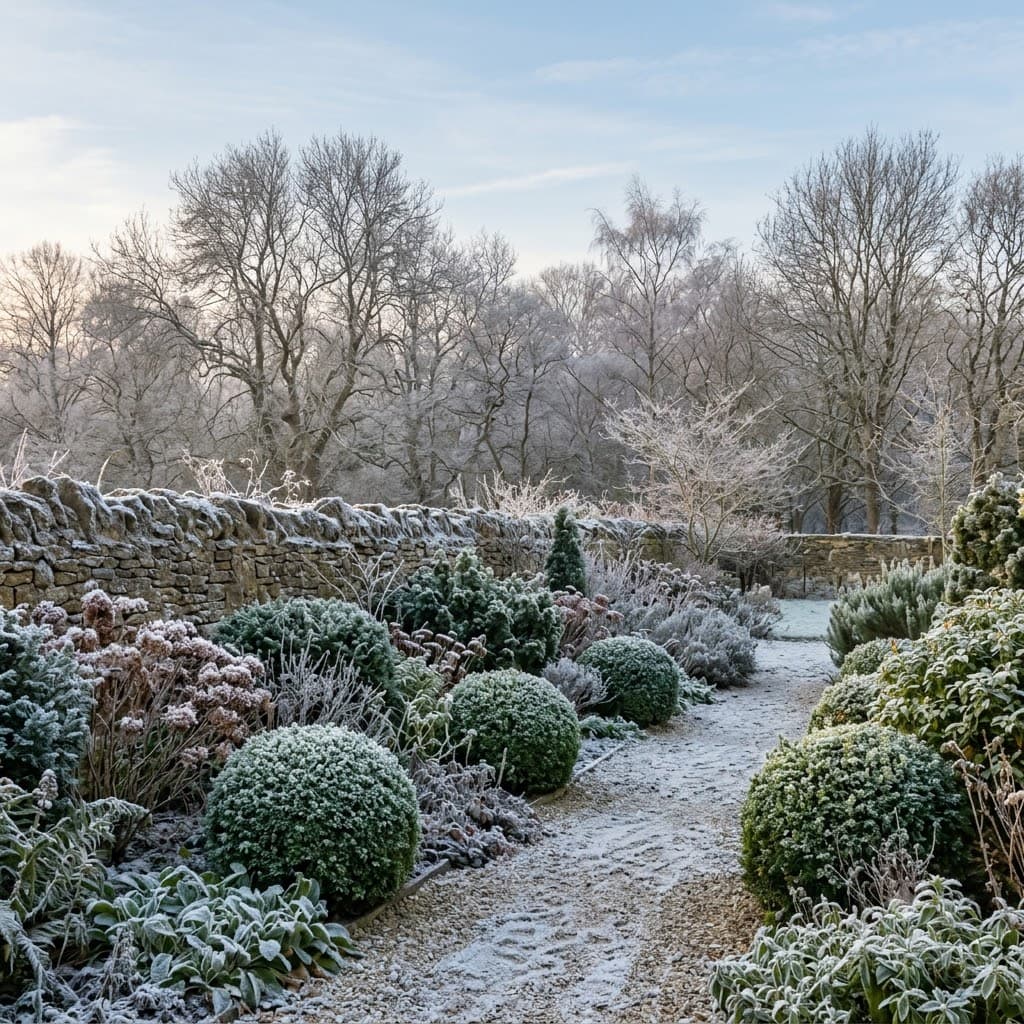
UK Hardiness Zones: What Planting Zone Is Your Region In?
On this page
The UK isn't one climate. A garden in Truro and a garden in Aberdeen might as well be on different islands when it comes to what survives the winter, so start with the table below and find your region.
Which Zone Is Your Region In?
Find your region, note the safe rating, then check the plant label: anything rated at that number or higher should come through a normal winter there.
| Region | Cities and towns | Safe rating | Approx. USDA zone |
|---|---|---|---|
| Isles of Scilly, far west Cornwall | St Mary's, Penzance | H3 | 10 |
| Rest of Cornwall, Devon, west Wales coast | Truro, Plymouth, Aberystwyth | H4 (H3 with shelter) | 9 |
| Southern and south-east England | London, Brighton, Southampton | H5 (H4 in most winters) | 8b to 9a |
| East Anglia | Norwich, Cambridge, Ipswich | H5 (H4 on sheltered sites) | 8 |
| Midlands and Welsh borders | Birmingham, Nottingham, Shrewsbury | H5 (H4 in most winters) | 8 |
| Northern England | Manchester, Leeds, Newcastle | H5, H6 on the Pennines and moors | 8a |
| Wales valleys and uplands | Brecon, Llandrindod Wells | H5, H6 on high ground | 8 |
| Scotland's Central Belt | Edinburgh, Glasgow | H5 | 8a |
| West coast of Scotland | Oban, Poolewe | H4 (H3 with real shelter) | 8b to 9 |
| Scottish Highlands and Northern Isles | Aviemore, Braemar | H6, H7 on exposed ground above 400m | 7 |
| Northern Ireland | Belfast, Derry | H5 inland, H4 on the coast | 8 to 9 |
These are broad averages. A south-facing wall or sheltered courtyard lets you go one step lower; a frost pocket, hilltop or exposed coast means going one step higher. For Northern Ireland, our Irish hardiness guide has a county-by-county table.
Why This Matters in Your Back Garden
Here's a scenario we hear about often. Someone in the Midlands falls in love with a planting scheme they saw in a gardening magazine, photographed in a walled garden in Cornwall. They plant the same things. Two winters later, half of it is gone, and they're left wondering what they did wrong.
Usually, the answer is nothing. The plants were simply never rated for the winter that Midlands garden actually gets. The magazine didn't lie, and the gardener didn't fail. The scheme worked perfectly for the climate it was photographed in. It just wasn't the reader's climate.
That's the whole reason hardiness ratings exist. Get the rating right for your specific patch of the UK and a border can go a decade with barely a casualty. Get it wrong and you'll be replanting the same corner every other spring, wondering why nothing "takes". The rest of this guide covers how the rating system works, where your part of the UK actually sits, and the things the number on the label won't tell you. If your garden is in Ireland rather than Britain, our companion piece on Irish hardiness zones covers the same ground for Irish conditions specifically.
The RHS Scale, Briefly
British and Irish gardens are rated on the RHS Hardiness Scale (H1 to H7), published by the Royal Horticultural Society. It runs from H1a (needs a heated glasshouse year-round) to H7 (survives conditions more severe than anywhere in the British Isles typically sees).
| Rating | Min Temperature | What it means in practice |
|---|---|---|
| H1a | Above 15°C | Tropical. Indoors only. |
| H1b | 10–15°C | Heated glasshouse year-round. |
| H1c | 5–10°C | Frost-free conditions. Cold greenhouse or conservatory. |
| H2 | 1–5°C | Tolerates mild frost. Needs winter protection outside the mildest coastal spots. |
| H3 | -5 to 1°C | Half-hardy. Reliable in the Isles of Scilly, Cornwall and other sheltered coastal gardens; needs a wall or coldframe further inland. |
| H4 | -10 to -5°C | Reliably hardy across most of lowland England and Wales. May need protection on exposed or northern sites. |
| H5 | -15 to -10°C | Hardy throughout the UK, including most of Scotland and elevated ground. |
| H6 | -20 to -15°C | Very hardy. Suitable for exposed upland and Highland conditions. |
| H7 | Below -20°C | Extremely hardy. Survives conditions more extreme than the UK ever sees in practice. |
If you'd rather see the full USDA conversion table alongside this — useful if you're used to American zone numbers, or you're comparing a UK garden to one in the US — we've built a dedicated RHS-to-USDA translator that covers it properly. The short version: the UK as a whole runs roughly USDA Zone 7 to Zone 10, with the coldest inland and upland spots at Zone 7 and the mildest coastal fringes touching Zone 10.
Where the UK Actually Sits on the Scale
This is the part that a single national answer can't give you. Here's the honest regional picture.
The Isles of Scilly and the far Cornish coast are the mildest ground in the UK, and it isn't close. Frost is rare, snow rarer still, and the Isles of Scilly grow subtropical plants — proteas, echiums, agapanthus by the acre — outdoors year-round. This is the UK's only reliable H3 territory at scale, broadly USDA Zone 10.
The rest of Cornwall, Devon, and the coastal fringe of west Wales sit a step colder but still mild by UK standards. Many H3 plants survive here without protection, particularly with a wall or hedge for shelter. Cordylines, tree ferns, and echiums are a familiar sight in gardens along this coast. Broadly H4, touching H3 in the most sheltered spots.
Southern and south east England, including London is where a lot of people assume the mildest UK climate lives, and it's a reasonable assumption but an incomplete one. This region is reliably H5, colder in a hard snap than the far south west, but critically drier — significantly drier than Wales, Cornwall, or most of Scotland. That dryness matters more than most gardeners expect: plants that need sharp drainage do better here than in wetter, milder parts of the country. Broadly USDA Zone 8b to 9a.
East Anglia is the UK's driest and most continental corner — proper cold snaps in winter, hot dry summers, and a wind that comes straight off the North Sea with nothing to stop it. Reliably H4 to H5, but treat exposed, unsheltered sites with caution regardless of the regional average.
The Midlands and Welsh borders are transitional territory — milder than the north, colder and wetter than the south east. H4 is sound for most winters; H5 is the safer baseline on higher or more exposed ground.
Northern England, from Manchester and Leeds up to Newcastle, is reliably H5, with the Pennines and North York Moors behaving more like H6 on exposed high ground. Coastal strips, sheltered by the sea's moderating effect, are a notch milder than inland valleys at the same latitude.
Wales beyond the coastal fringe — the valleys and uplands — follows the same logic as northern England: H5 as a working baseline, colder on exposed high ground, milder in sheltered lowland pockets.
Scotland's Central Belt, running through Edinburgh and Glasgow, is broadly H5, comparable to northern England. The west coast of Scotland benefits from the same Gulf Stream effect that warms western Ireland, and can support H3 plants in genuinely sheltered spots — Scotland's famous west coast gardens, including Inverewe, are built on exactly this quirk.
The Scottish Highlands and Northern Isles are the hardest conditions the UK has. Exposed glens and elevated ground regularly see genuine H6 conditions, and the most exposed sites above 400m should be planted for H7. This is USDA Zone 7 territory, colder than anywhere else covered in this guide.
Northern Ireland sits climatically with the rest of the island of Ireland rather than with Great Britain — our Irish hardiness guide covers it in the regional detail it deserves.
The Things the Rating Doesn't Tell You
A hardiness rating describes minimum temperature tolerance under average conditions. It says nothing about three things that, in a UK garden, often matter more than the number itself.
Drainage. This catches out more UK gardeners than genuine cold does. A plant rated H4 or H5 — good down to -10°C — can still die in a mild English winter if its roots are sitting in waterlogged soil from October to March. Mediterranean-origin plants (lavender, rosemary, most salvias) are the classic victims: rated hardy enough for the temperatures they'll face, but killed by sustained wet rather than frost. This is a large part of why the same "hardy" plant thrives in the well-drained soils of the south east and struggles in heavier ground further north or west.
Wind. Exposure increases effective cold through wind-chill and physically damages growth through desiccation and breakage. A coastal Scottish or Welsh garden that rarely sees a hard frost can still lose a borderline shrub to salt-laden gales that a inland garden two degrees colder would never experience.
Aspect and microclimate. A south-facing wall adds roughly one hardiness step in practical terms. Gardeners across the Midlands, the north, and even Scotland successfully grow plants rated a full band below their region's average against a warm, sheltered wall — the same trick that lets London gardeners grow Ceanothus and Fremontodendron that would struggle in an open border.
The hardiness rating describes the plant at its toughest. Your specific garden — its wall, its slope, its drainage — decides whether it ever has to be.
Four Plants Across the UK's Range
Phormium tenax
Phormium tenax
H3New Zealand flax. A familiar architectural presence in coastal Cornish and West Country gardens, reliable in mild sheltered spots. Inland or in a hard winter, foliage can be badly scorched or the whole plant lost — treat it as borderline outside the mildest coastal counties.
Trachycarpus fortunei
Trachycarpus fortunei
H4The Chusan palm, the most cold-hardy trunked palm widely available in the UK. Grows outdoors as far north as Yorkshire and southern Scotland with shelter, though growth is slower and less lush than in the mild south west. A useful test case for how far 'exotic' planting genuinely stretches across the UK.
Skimmia japonica
Skimmia japonica
H6A shade-tolerant evergreen shrub, fully reliable across the whole of the UK including most of Scotland and the north. Fragrant late-winter flowers, tolerates poor light and exposed sites, and asks for almost nothing once established.
Betula pendula
Betula pendula
H7Silver birch, native across the UK and reliably hardy in every region this guide covers, including the Highlands. Zero hardiness anxiety, tolerant of poor soil and exposure, and one of the few trees that looks equally at home in a Cornish garden or a Highland glen.
Frequently Asked Questions
What planting zone is the UK in?
The UK spans RHS zones H3 to H7 depending on region — there is no single answer for the whole country. Most lowland English and Welsh gardens sit in H4 to H5. The mildest coastal fringes (Isles of Scilly, west Cornwall) reach H3; the Scottish Highlands and exposed uplands reach H6 to H7. In USDA terms, that's roughly Zone 7 in the coldest inland and upland areas up to Zone 10 in the mildest coastal pockets.
What hardiness zone is Manchester?
Manchester and the wider north west of England are broadly H5, similar to most of northern England. USDA equivalent is approximately Zone 8a. Elevated ground on the edge of the Pennines runs a notch colder.
What hardiness zone is Edinburgh?
Edinburgh and Scotland's Central Belt are broadly H5, comparable to northern England. USDA equivalent is approximately Zone 8a. The west coast of Scotland, benefiting from the Gulf Stream, can be milder in sheltered spots; the Highlands to the north are considerably harder, at H6 to H7.
Is the south of England always the mildest part of the UK?
Not quite. Southern and south east England, including London, is reliably mild in winter but it's also the driest part of the UK by some distance. The far south west (Cornwall, Devon, the Isles of Scilly) is milder still in terms of minimum temperature and is also wetter. For plants that need both mild winters and sharp drainage, the south east often outperforms the milder but wetter south west — it depends what you're growing.
What's the USDA equivalent of the UK as a whole?
Roughly Zone 7 to Zone 10. Zone 7 covers the coldest inland and upland areas of Scotland, northern England and Wales. Zone 8 covers most of lowland England, Wales, and Scotland's Central Belt. Zone 9 covers southern England and the mildest coastal areas. Zone 10 is reserved for the Isles of Scilly and the very mildest coastal fringes of Cornwall. For the full conversion table and the reasons a straight zone-for-zone swap can mislead you, see our RHS-to-USDA translator.
Why does my garden underperform compared to the regional average?
Almost always aspect, drainage, or exposure. The regional hardiness figures in this guide are averages across a wide area — your specific garden can sit a full hardiness band either side of that average depending on whether it's a frost pocket or a sheltered suntrap. Local conditions consistently overrule the regional number.
A Note on a Shifting Climate
The regional picture above is accurate for the climate the UK has now, but that climate is not the one it had a generation ago. The Met Office's Central England Temperature record — the longest continuous instrumental temperature series in the world, running since 1659 — shows the growing season has lengthened by roughly a month compared with the 1961 to 1990 average, driven mainly by earlier springs and fewer hard frosts. Plants once considered borderline across much of England are now overwintering reliably further north and further inland than they used to. We've written about what that shift looks like in practical terms in Your Own British Vineyard, which traces the same warming through the rise of English sparkling wine.
Related Notes
- Plant Hardiness in Ireland: A Beginner's Guide
- RHS Hardiness vs USDA Zones: A Quick Translator
- Your Own British Vineyard: The Quiet Climate Shift
- What Do the Symbols on Your Plant Label Actually Mean?
- Low Maintenance Garden Ideas by Climate Zone
- Surviving a Hosepipe Ban: What Actually Works When You Can't Water the Garden
- What Will Grow in a North-Facing Garden?
References
- Royal Horticultural Society, RHS Hardiness Ratings
- Met Office, UK Climate Averages
- Met Office, Central England Temperature — the longest continuous instrumental temperature record in the world
- USDA Agricultural Research Service, Plant Hardiness Zone Map
See It in Your Own Garden
Your region's rating tells you what should survive. Your own garden's soil, shelter and aspect decide what will actually thrive. The Dedrab Garden Action Plan starts from a photo of your garden and suggests a redesign and planting plan matched to your climate, so you can see what works before you spend. Try it at dedrab.com.