What Do the Symbols on Your Plant Label Actually Mean?
On this page
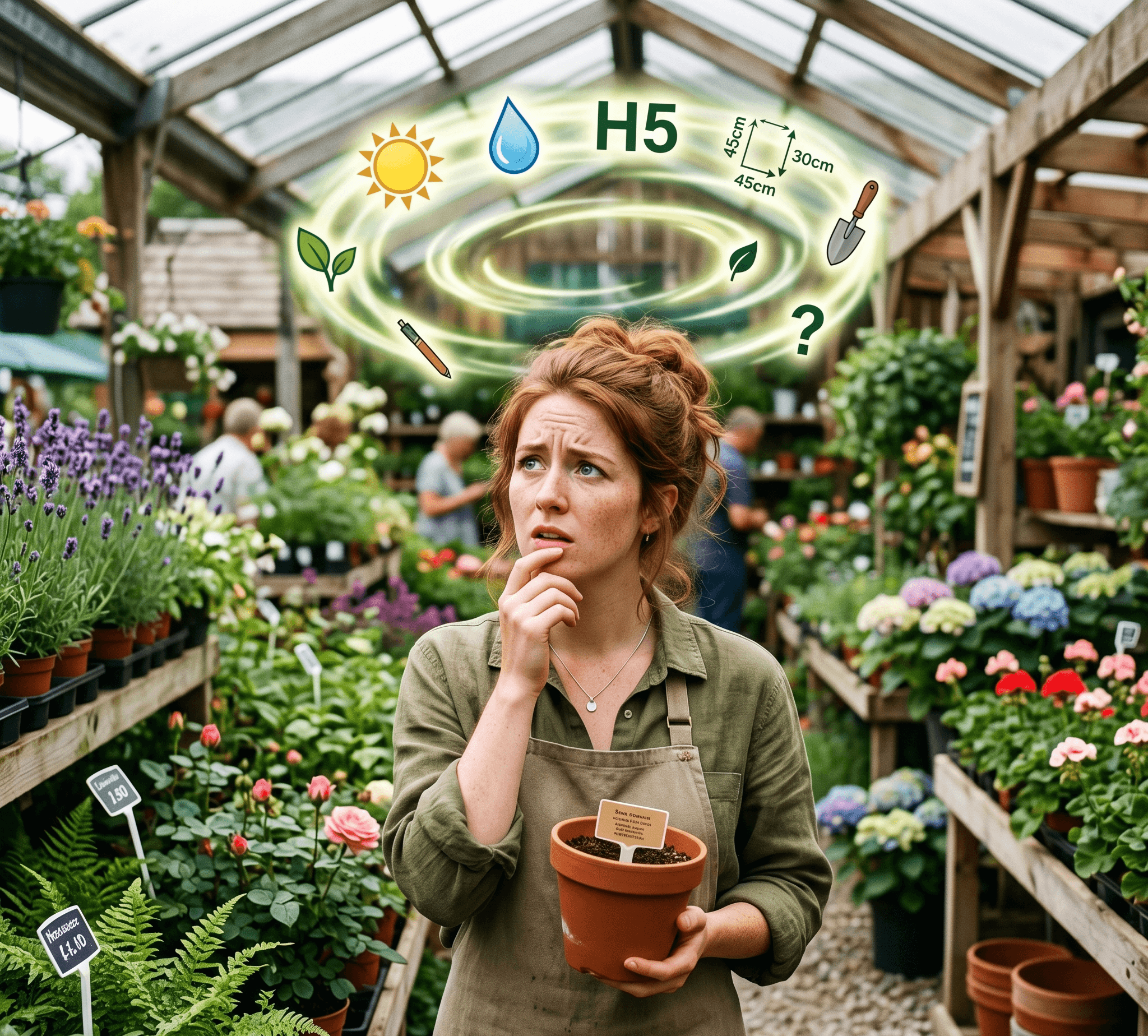
You walk into the garden centre on a Saturday morning, find a plant that looks gorgeous, and pick it up to read the label. There's a sun icon, a water droplet, two numbers separated by a slash, an "H" with a number after it, a small box with letters, and a price you weren't quite expecting. Most of it is unexplained. Most people put the plant down, buy it anyway, plant it where it looks nice, and hope for the best.
That's the wrong outcome. The information on a plant label, properly read, tells you whether the plant will survive your winter, whether your soil suits it, how big it will get, and how much work it will need. We've seen enough gardens where the wrong plant was put in the wrong place to know that ten minutes spent decoding a label saves years of replacement and disappointment. So here's the plain-language version of every line on the label that nobody ever sat you down and explained.
The Hardiness Rating (the most important line)
The single most useful piece of information on the label is the hardiness rating. In Ireland and the UK, you'll see this as an "H" followed by a number: H1, H2, H3, H4, H5, H6 or H7. The higher the number, the more cold the plant can survive. H5 is reliable across nearly all of Ireland and most of the UK. H3 means the plant is borderline tender and will need shelter or be lost in a hard winter.
If the plant comes from an American supplier, you'll see a USDA zone number (1 to 13) instead, calibrated against different climate norms. Both systems are trying to answer the same question — will this survive your winter — and we've written a full beginner-friendly walkthrough of how the ratings work, where Ireland and the UK sit on the scale, and how to translate between them, in our note on plant hardiness for beginners.
If you ignore everything else on the label, don't ignore the H number.
Sun and Shade Icons
Three icons cover this, usually drawn as small suns and clouds:
- Full sun is a fully-shaded sun symbol, sometimes labelled "needs direct sunlight" or showing six or more hours of direct light per day.
- Partial shade (also called "partial sun") usually shows a half-shaded sun, indicating around three to six hours of direct light, often with shade during the hottest part of the afternoon.
- Full shade is a cloud or a darkened sun, indicating less than three hours of direct sunlight, typically morning sun only or dappled light all day.
A "full sun" plant in a north-facing border won't die immediately. It will just gradually fail to thrive, flower less and less each year, and eventually be replaced by you blaming yourself. The opposite mistake — putting a shade lover in full midday sun — usually shows itself faster: scorched leaves and a plant that wilts every dry afternoon.
Soil and Moisture Symbols
You'll often see a small set of icons or words indicating soil preference:
- Well-drained soil is the most common. The plant doesn't want to sit in water. Heavy clay that puddles for days after rain is bad news for most plants with this label.
- Moisture-retentive or "moist but well-drained" wants soil that holds onto water without becoming waterlogged. Most herbaceous perennials want this.
- Drought-tolerant plants are happy in dry soils once established, often Mediterranean in origin. The qualifier is "once established" — they still need watering through their first summer.
The drainage detail matters more in Ireland and the wetter parts of the UK than the temperature rating does. Mediterranean plants rated H4 or H5 die more often from waterlogged winter soil than from frost. We've covered this drainage-versus-cold trap in detail in our note on low maintenance garden ideas by climate zone, because it catches almost every new gardener.
The Two Numbers Separated by a Slash
The first number is the eventual height, the second is the eventual spread. So "60/45 cm" means the plant will reach roughly 60 centimetres tall and 45 centimetres wide at maturity. "Eventual" usually means around five to ten years, depending on growth rate.
People underestimate this constantly. A shrub labelled "1.5/1.5 m" looks tiny in a 2-litre pot in spring. Three summers later, it's two-and-a-half feet across and shading out the perennials you planted next to it. The spacing rule of thumb is to plant slightly closer than the eventual spread (perennials especially benefit from this for that lush filled-in look), but understand what you're committing to.
Flowering Season and Seasonal Interest
The label will usually tell you when the plant flowers, often as a small bar showing months of the year shaded in. Pay attention to this for two reasons. First, you want to build a garden that does something in every month, not one that peaks in June and looks sad for the rest of the year. Second, the months on the label are calibrated against the original climate the plant was bred or selected in — actual flowering in your garden may be a couple of weeks earlier or later depending on local conditions.
Some labels also note autumn colour, winter interest (bark, structure, evergreen foliage), or fragrance. These are easy to overlook and quietly the difference between a garden that's interesting all year and one that's only interesting in June.
The AGM Badge
If you see a small cup or trophy icon with "AGM" beside it, that's the Award of Garden Merit from the Royal Horticultural Society. The RHS runs trials on plants under typical UK and Irish conditions and gives the AGM to varieties that perform reliably, look good, and are reasonably available. It's not a marketing badge — it's a working signal that the plant has been independently assessed and recommended.
If you're new to gardening, sticking to AGM-marked varieties is a reasonable shortcut to plants that genuinely perform.
Hazards, Toxicity and Pets
Some labels carry small warning symbols indicating the plant is toxic if eaten, irritates skin on contact, or has thorns. The Royal Horticultural Society maintains a list of plants known to be harmful to pets and children. If you have a dog that eats things, a cat that grazes on foliage, or small children who can't be relied upon not to put a leaf in their mouth, check the label and look up anything you don't recognise. Foxgloves, oleander, certain lilies and yew are common and beautiful, and all of them have real toxicity considerations.
Pollinator Friendly Marks
Some growers include a small bee icon to indicate the plant is good for pollinators. This is voluntary and not standardised, but it's a useful signal. The RHS publishes a "Plants for Pollinators" mark with similar intent. If wildlife and pollinators are part of why you're gardening, build a meaningful proportion of your borders around plants that carry these marks.
What the Label Doesn't Tell You
The label is honest about what the plant wants in ideal conditions. It can't tell you about your specific site. Your soil might be sharper-draining than typical clay loam. Your garden might be in a frost pocket two degrees colder than the regional average. Your wall might add a hardiness step. The plant care plate is a starting point, not a guarantee.
What we've found is that the gardeners who consistently get good results are the ones who treat the label as the first piece of evidence, not the final word. They read it carefully, but they also read their own garden — the way the light moves through it during the day, where water sits after rain, what already grows well nearby — and make decisions on the combination.
If reading your garden the way an experienced designer would is the bit you find hard, that's exactly the problem dedrab solves.
Related Notes
- Plant Hardiness in Ireland: A Beginner's Guide to What the Ratings Actually Mean
- RHS Hardiness vs USDA Zones: A Quick Translator for British, Irish and American Gardeners
- Low Maintenance Garden Ideas by Climate Zone
- Plants That Earn Their Keep in a Temperate Garden
A plant label tells you what the plant wants. A site-specific planting plan tells you whether your garden can give it that. Dedrab turns a single photo of your garden into a planting plan with hardiness, aspect and soil all factored in. Try it at dedrab.com.
References
- Royal Horticultural Society, RHS Hardiness Ratings
- Royal Horticultural Society, Award of Garden Merit (AGM)
- Royal Horticultural Society, Plants for Pollinators
- Royal Horticultural Society, Potentially harmful garden plants
- USDA, Plant Hardiness Zone Map