
What Planting Zone Is Ireland In? Hardiness Zones by County
On this page
- Which Zone Is Your County In?
- Why This Matters in Your Back Garden
- Two Systems, One Question
- The RHS Scale Explained
- If You're Coming from USDA Zones
- Where Ireland and the UK Sit on the Scale
- The Things Hardiness Ratings Don't Tell You
- Reading the Label: A Practical Approach
- Four Plants That Illustrate the Scale
- Frequently Asked Questions
- A Note on a Shifting Climate
- Related Notes
- See It in Your Own Garden
The table gives you the coldest temperature recorded at the Met Éireann weather station nearest your county, and the hardiness rating that covers it. The rest of this guide explains what the ratings mean and what the number on the label won't tell you.
Which Zone Is Your County In?
Find your county, note the safe rating, then check the plant label: anything rated at that number or higher should come through a hard winter.
| County | Coast or inland | Nearest Met Éireann station | Air frosts a year | Coldest recorded | Safe rating |
|---|---|---|---|---|---|
| Kerry | Atlantic coast | Valentia | 8.5 | -7.7°C | H4 (H3 with shelter on the coast) |
| Cork, Waterford | South coast, colder inland | Cork Airport | 14.5 | -7.2°C | H4 (H3 with shelter on the coast) |
| Wexford | South-east coast | Rosslare* | 4.8 | -4.4°C | H4 (H3 with shelter on the coast) |
| Clare, Limerick | Shannon estuary | Shannon Airport | 20.3 | -11.4°C | H5 (H4 in most winters) |
| Mayo coast, Sligo, west Galway | Atlantic coast | Belmullet | 10.4 | -7.8°C | H4 |
| Roscommon, Leitrim, east Galway, inland Mayo | Inland west | Claremorris* | 39.5 | -12.9°C | H5 |
| Donegal | North coast | Malin Head | 7 | -5.2°C | H4 on the coast, H5 inland and on high ground |
| Dublin, Louth | East coast | Dublin Airport | 35 | -12.2°C | H5 (H4 in most winters) |
| Kildare, Meath, lowland Wicklow | Inland east | Casement Aerodrome | 34.8 | -15.7°C | H5, or H6 on exposed sites |
| Westmeath, Longford | Midlands | Mullingar* | 43 | -14.9°C | H5 |
| Offaly, Laois, north Tipperary | Midlands | Birr* | 38.8 | -14.6°C | H5 |
| Kilkenny, Carlow, south Tipperary | Inland south-east | Kilkenny* | 46.9 | -14.1°C | H5 |
| Cavan, Monaghan | Inland north | Clones* | 38.4 | -12.4°C | H5 |
| Northern Ireland | Coast and inland | Met Office stations | See Met Office | See Met Office | H5 inland, H4 on the coast |
The safe rating covers the coldest night on record nearby, so it's cautious on purpose. In an ordinary winter you can go one step lower (an H4 plant in an H5 county) against a south-facing wall or in a sheltered corner. Hills, frost pockets and exposed sites run colder than the weather station, so go one step higher there.
Figures come from Met Éireann's published averages: 1991 to 2020 for the stations still open, and the last 30 years of records for stations marked * (1971 to 2000 for Claremorris). "Air frosts a year" is the average number of days the air temperature drops below 0°C.
Why This Matters in Your Back Garden
Picture this: you bring home a beautiful new shrub from the garden centre on a sunny April afternoon. You plant it carefully, water it through summer, and then — sometime in February — you find it brown, brittle, and beyond rescue. What happened?
In most cases, the answer is on the label you didn't read closely enough. The little H-number — H3, H4, H5 — is the difference between a plant that quietly does its job for the next decade and one you'll be digging out by spring. We've seen this story play out in countless gardens. People often blame themselves, or assume they "killed it." The truth is usually simpler and less personal: the plant was rated for a milder winter than yours has.
Hardiness is the quiet hero of garden longevity. Get it right and the garden gets easier every year. Get it wrong and you'll be replacing the same dead patch every other spring. The rest of this guide walks through how to read the ratings, where Irish and British gardens sit on the scale, how to translate from American zones — and just as importantly, when the number on the label tells you only half the story. If you're looking for plants that especially repay this kind of attention, our note on plants that earn their keep in a temperate garden is a good next stop.
Two Systems, One Question
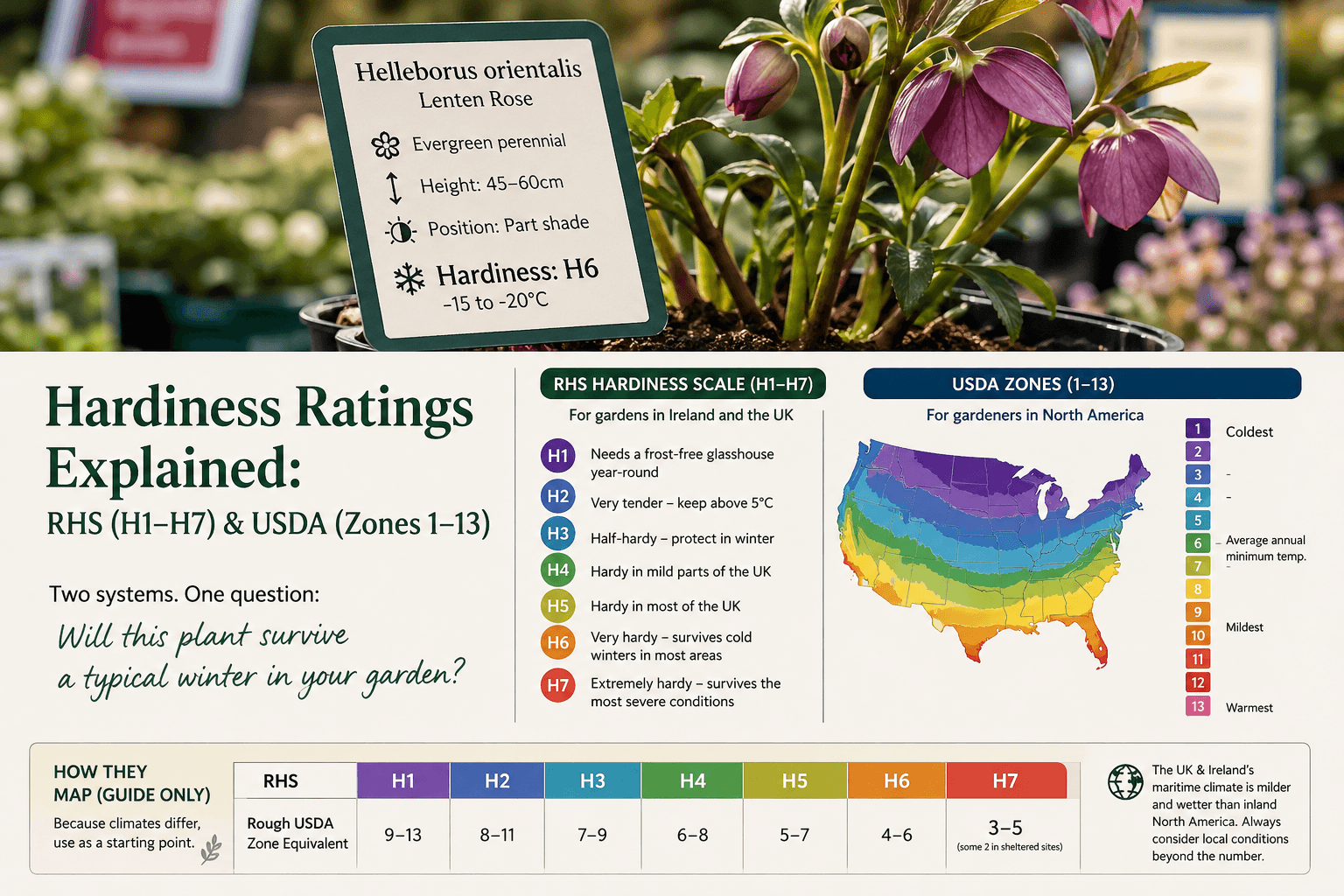
Hardiness ratings answer a single question: will this plant survive a typical winter in your garden?
There are two systems you'll encounter:
The RHS Hardiness Scale (H1–H7) is the one that matters most for gardens in Ireland and the UK. Published by the Royal Horticultural Society, it runs from H1 (needs a frost-free glasshouse year-round) to H7 (survives the most extreme conditions on the British Isles). When you see "H4" or "H6" on a plant label, a nursery catalogue, or in a garden book, this is the scale being referenced.
USDA Zones (1–13) is the American system, built around average annual minimum temperatures. It's widely used in plant literature because so much horticultural publishing originates in North America, and most online plant databases carry USDA ratings as standard. For gardeners in Ireland and the UK, it maps imperfectly — the maritime climate of the Atlantic coast is mild and wet in ways the USDA scale, calibrated for continental North American winters, doesn't fully capture. For US gardeners visiting this guide, the conversion table below gives you a practical bridge.
The RHS Scale Explained
Here's what each rating means in plain terms:
| Rating | Min Temperature | What it means in practice |
|---|---|---|
| H1a | Above 15°C | Tropical. Indoors only. |
| H1b | 10–15°C | Heated glasshouse year-round. |
| H1c | 5–10°C | Frost-free conditions. Cold greenhouse or conservatory. |
| H2 | 1–5°C | Tolerates mild frost. Needs winter protection in all but the mildest locations. |
| H3 | -5 to 1°C | Half-hardy. Survives most coastal Irish and southwest UK winters, needs shelter inland. |
| H4 | -10 to -5°C | Reliably hardy across most of Ireland and the UK. May need protection in severe winters or exposed northern sites. |
| H5 | -15 to -10°C | Hardy throughout Ireland and the UK, including Scotland and elevated ground. |
| H6 | -20 to -15°C | Very hardy. Suitable for the full range of conditions across both islands, including exposed highland sites. |
| H7 | Below -20°C | Extremely hardy. Survives conditions more extreme than the British Isles ever sees. |
For most gardeners in Ireland and the UK, the working range is H4 to H7. H5 and above can be planted and left to its own devices. H4 is reliable for the vast majority of locations. H3 is where judgement calls begin.
If You're Coming from USDA Zones
For gardeners in the United States, here's a practical conversion between USDA zones and the RHS scale. Note that the equivalencies are approximate — the systems measure different things, and the maritime climate of Ireland and the UK behaves differently from continental zones at equivalent temperatures:
| USDA Zone | Approx RHS equivalent | Notes |
|---|---|---|
| Zone 5 | H7 | Colder continental winters — think Chicago, Denver |
| Zone 6 | H6–H7 | Pacific Northwest higher elevations, New England |
| Zone 7 | H5–H6 | Pacific Northwest, mid-Atlantic states |
| Zone 8 | H4–H5 | Seattle, coastal Pacific Northwest, parts of the US South |
| Zone 9 | H3–H4 | California coast, Gulf Coast, parts of the South |
| Zone 10 | H2–H3 | Florida, Southern California |
Most of Ireland sits in the USDA Zone 8–9 range in terms of raw minimum temperature, but the comparison is imperfect. A USDA Zone 9 garden in California has hot, dry summers followed by mild, dry winters. An Irish garden has cool, wet summers and mild, wet winters. The cold rarely goes as low, but the constant moisture creates plant health challenges the USDA scale doesn't account for. More on that below.
Where Ireland and the UK Sit on the Scale
Ireland
Most of Ireland's lowland gardens fall into the zone where H4 and H5 plants are fully reliable. But Ireland is not climatically uniform, and the variation matters.
The Atlantic seaboard — west and south coasts of Cork, Kerry, Clare, Galway, and parts of Sligo and Mayo — has the mildest winters in Ireland. The Gulf Stream effect keeps hard frosts rare at sea level. Many H3 plants survive here without protection. Exotic-looking gardens with tree ferns (Dicksonia antarctica), cordylines, and bananas (Musa basjoo, treated carefully) are not unusual on the Beara Peninsula or the Ring of Kerry.
Dublin, Leinster, and the east coast are generally a degree or two colder than the west in winter, more continental in character, and notably drier. Reliable to H5; H4 is sound for most winters. H3 plants in Dublin need a sheltered south or west-facing wall at minimum.
The midlands and elevated ground are the hardest areas. Exposed to cold northerly and easterly airflows without the moderating influence of the Atlantic, gardens in Roscommon, Longford, or above 150m should treat H5 as the minimum reliable threshold and view H4 with caution.
Northern Ireland broadly follows the same rules as the northeast, with slightly colder winters on elevated and exposed inland sites.
The UK
The UK spans a wider climatic range than Ireland, and the regional variation is significant. If you garden in Britain rather than Ireland, our companion piece, What Planting Zone Is the UK In?, goes into that regional breakdown in full, from the Isles of Scilly to the Scottish Highlands.
Cornwall, Devon, and the west coast of Wales are the closest UK equivalent to the Irish Atlantic seaboard — mild, wet, and sheltered enough to support H3 plants without protection in most winters. The famous gardens of Cornwall grow plants that would need a greenhouse almost anywhere else in Britain.
Southeast England and the London area is the outlier that catches many gardeners out. It is harder in winter than the southwest (reliably H5, with colder snaps than Ireland's east coast) but critically, it is drier — significantly drier than Ireland, Wales, or northwest England. This changes the calculus for Mediterranean-origin plants rated H4–H5 that die in wet Irish conditions but thrive in the better-draining southeast English soils. Lavender, rosemary, and many salvias that struggle in Irish gardens perform reliably in Surrey or Kent.
Northern England and the English Midlands are reliably H5 territory in most lowland gardens, with exposed elevated sites on the Pennines or North York Moors behaving more like H6 in practice.
Scotland spans the full range. Edinburgh and the Central Belt are broadly H5, comparable to the Irish midlands. The west coast of Scotland — benefiting from the same Gulf Stream influence as western Ireland — can support H3 plants in sheltered positions. The Scottish Highlands are the hardest conditions in the British Isles: elevated glens regularly experience genuine H6 conditions, and exposed sites above 400m should be planted accordingly.
The Things Hardiness Ratings Don't Tell You
Here is the part of the hardiness conversation that most labels and catalogues skip over: the rating describes minimum temperature tolerance under average winter conditions. It tells you nothing about the following factors, all of which can kill a theoretically hardy plant:
Drainage. In Ireland, and to a lesser extent in the wetter parts of the UK, this is the number one cause of plant death — not cold itself, but cold combined with waterlogged soil. A plant rated H5 that sails through a -12°C dry continental winter can be killed by a mild Irish winter if its roots are sitting in standing water from October to March. Lavandula, Salvia rosmarinus, and most other Mediterranean plants rated H4–H5 die in Ireland not from frost but from saturated soil. This is why southeast England often grows them successfully at the same or colder temperatures than western Ireland. We've dug into this drainage-versus-cold question in more depth in our note on low maintenance garden ideas by climate zone, which covers the Mediterranean planting paradox in detail.
Wind. Wind desiccates leaves, snaps stems, and increases effective cold through wind-chill. A coastal location that almost never frosts can still kill a borderline-tender shrub through salt spray and gale-force exposure. This is why the lush exotic gardens of the west coast of Ireland and Cornwall rely on shelter belts and hedging as much as mild temperatures.
Late frosts. Springs in Ireland and across much of the UK are treacherous. A warm March encourages early growth, and a sharp frost in mid-April catches tender new shoots. The hardiness rating of a plant refers to its established, dormant state in midwinter. Young growth in spring is always more vulnerable. The traditional guidance — don't plant out frost-tender subjects before the late spring bank holiday — still holds for good reason.
Aspect and microclimate. A south-facing wall adds the equivalent of approximately one hardiness step in practical terms. Plants rated H3 can be grown successfully in most of Ireland and the UK against a south or west-facing wall that stores daytime heat and provides shelter from cold north and east winds. This is how gardeners in Dublin and London grow Ceanothus, Fremontodendron, and Cytisus battandieri that would struggle in an open border.
The hardiness rating describes the plant at its toughest. Your garden's microclimate determines whether it gets to be that tough.
Reading the Label: A Practical Approach
When you pick up a plant in a garden centre, here's how to use the hardiness information:
Check the H-rating first
H4 or above means it's reliable for most gardens in Ireland and the UK. H3 requires a specific location with natural shelter. H2 or below needs a frost-free winter home. If you only see a USDA zone, use the conversion table above as a guide.
Check the drainage requirement
Mediterranean-origin plants with H4–H5 ratings often need sharp drainage to survive Atlantic winters. In wetter parts of Ireland and the UK, this can matter more than the cold tolerance figure.
Consider your microclimate
A south-facing wall, a sheltered courtyard, or the lee side of a mature hedge can support plants one rating step below what your open garden would otherwise handle.
Check the AGM mark if in doubt
The RHS Award of Garden Merit (AGM) indicates a plant that has performed reliably in RHS trials — a useful secondary signal that a plant does what it claims and handles UK and Irish conditions as rated.
Four Plants That Illustrate the Scale
Agapanthus 'Headbourne Hybrids'
Agapanthus 'Headbourne Hybrids'
H4One of the hardier agapanthus selections, borderline in exposed Irish midland gardens but reliable in most coastal, urban Irish, and southeast English locations. Needs sharp drainage — waterlogged winter soil kills it regardless of air temperature. Broadly equivalent to USDA Zone 8.
Cordyline australis
Cordyline australis
H3The 'Torbay palm', a fixture of west coast Irish and Cornish gardens. Reliable in mild coastal locations on both islands. In Dublin, inland UK, or exposed sites, it survives mild winters but can be killed or badly disfigured in a sharp freeze. Recovers from the base if the crown is lost.
Geranium 'Rozanne'
Geranium 'Rozanne' (Gerwat)
H7The most reliably trouble-free perennial for gardens across Ireland and the UK — and much of the US. Fully hardy everywhere, thrives in a wide range of soils, flowers from June to October without deadheading. Zero hardiness anxiety. USDA Zone 5 and above.
Sarcococca hookeriana var. digyna
Sarcococca hookeriana var. digyna
H5Winter box. Small evergreen shrub with remarkable fragrance in January and February. Fully hardy throughout Ireland and the UK, tolerates deep shade, requires almost no maintenance. One of the most underplanted shrubs in Atlantic climate gardens.
Frequently Asked Questions
What hardiness zone is Dublin?
Dublin is broadly equivalent to RHS H5 in open gardens, meaning plants rated H5 and above are fully reliable. H4 plants are sound for most winters. The city's urban heat island effect makes inner-city gardens slightly milder than suburban ones; elevated or north-facing suburban sites are slightly harder. In USDA terms, Dublin is approximately Zone 8b–9a.
What hardiness zone is London?
London open gardens are broadly equivalent to RHS H5, similar to Dublin but with one key difference: southeast England is significantly drier. This means plants rated H4–H5 that require good drainage — lavender, rosemary, many salvias — perform more reliably in London and the southeast than in equivalent Irish gardens. Urban London is approximately USDA Zone 9a due to the heat island effect; suburban and outer London is Zone 8b.
I'm used to USDA zones — how do I use the RHS scale?
Start with the conversion table above. As a working rule: USDA Zone 7 ≈ RHS H5, USDA Zone 8 ≈ RHS H4–H5, USDA Zone 9 ≈ RHS H3–H4. The bigger adjustment for US gardeners moving to Ireland or the UK is not cold tolerance but drainage tolerance — many plants that thrive in dry USDA Zone 9 gardens (coastal California, the Gulf Coast) will fail in an Irish or British winter not because of the temperature but because of sustained wet. If a plant's cultural notes say "well-drained soil" or "drought-tolerant", treat that as a warning flag for Atlantic climate gardens.
What is the difference between RHS hardiness ratings and USDA zones?
RHS ratings (H1–H7) are based on minimum winter temperatures as experienced in the UK and Ireland, calibrated for maritime conditions. USDA zones (1–13) use average annual minimum temperatures, calibrated for the more extreme continental conditions of North America. Neither system accounts for drainage, wind exposure, or late frost risk — the factors that most often determine success or failure in Atlantic climate gardens.
Can I grow H3 plants in Ireland or the UK?
Yes, in the right conditions. H3 plants survive most coastal west and south Irish winters without protection, and perform similarly in Cornwall, Devon, and the west coast of Wales and Scotland. In exposed, inland, or elevated gardens, they need a sheltered south or west-facing position. Many H3 plants are also successfully overwintered in a frost-free greenhouse or coldframe.
Why do my lavender plants keep dying in winter?
Almost certainly drainage, not cold. Lavender is rated H5 — it handles the temperatures of any Irish or UK winter. What kills it in Atlantic climate gardens is prolonged wet at the roots from autumn through spring. Plant in raised beds, gravel gardens, or containers with very free-draining compost. Avoid heavy clay or low-lying positions. Gardeners in southeast England can plant it in open borders where it would die in a comparable Irish or Welsh garden.
Is there a hardiness map I can use?
Met Éireann publishes climate data for Ireland; the Met Office covers the UK. The RHS plant search tool includes a hardiness map covering both islands. For practical purposes: assume H5 as your baseline anywhere in Ireland or the UK and adjust up or down based on your specific conditions — aspect, shelter, elevation, and soil drainage. These local factors routinely matter more than the regional average.
A Note on a Shifting Climate
One thing the H-numbers don't show is that the climate they were calibrated against is changing. Met Éireann's records show Ireland's annual mean temperature has risen noticeably over the past century; the Met Office's Central England Temperature series — the longest continuous temperature record in the world — tells a similar story for the UK. Growing seasons are longer, hard frosts less frequent, and plants we'd have written off as unreliable a generation ago now thrive in places they shouldn't. We've written about this in two companion pieces — Your Own Irish Vineyard and Your Own British Vineyard — looking at what climate shift means in practical garden terms.
Related Notes
- What Planting Zone Is the UK In? RHS H3 to H7 Explained
- What Do the Symbols on Your Plant Label Actually Mean?
- RHS Hardiness vs USDA Zones: A Quick Translator for British, Irish and American Gardeners
- Your Own Irish Vineyard: How Climate Change Quietly Turned Ireland Into Wine Country
- Your Own British Vineyard: The Quiet Climate Shift That's Made Grapes a Garden Crop
- Surviving a Hosepipe Ban: What Actually Works When You Can't Water the Garden
- Low Maintenance Garden Ideas by Climate Zone
- Plants That Earn Their Keep in a Temperate Garden
References
- Met Éireann, 30 year averages (station tables for Valentia, Cork Airport, Shannon Airport, Belmullet, Malin Head, Dublin Airport, Casement, Rosslare, Claremorris, Mullingar, Birr, Kilkenny and Clones)
- Met Éireann, Climate of Ireland
- Royal Horticultural Society, RHS Hardiness Ratings
- Met Office, UK Climate Averages
- USDA Agricultural Research Service, Plant Hardiness Zone Map
See It in Your Own Garden
Your county's rating tells you what should survive. Your own garden's shelter, soil and aspect decide what will actually thrive. The Dedrab Garden Action Plan starts from a photo of your garden and suggests a redesign and planting plan matched to your climate, so you can see what works before you spend. Try it at dedrab.com.