
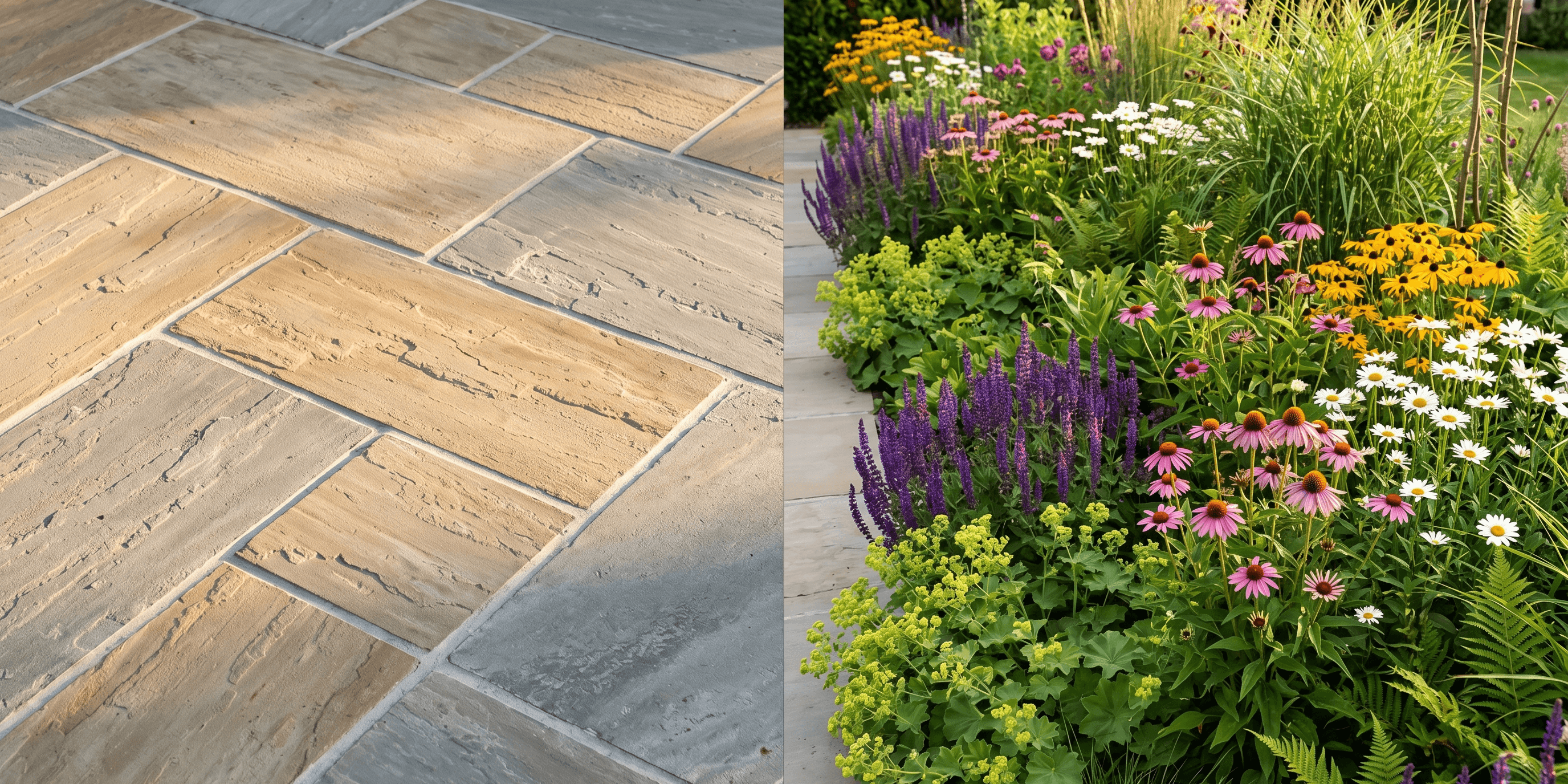
Hard Ground, Soft Touch: Understanding What Your Garden Is Actually Made Of
On this page
If you have spent any time reading about garden design or talking to a landscaper, you will have encountered the terms "hard landscaping" and "soft landscaping." They are used constantly, often without explanation, in a way that assumes you already know the difference. Most people nod along and work it out eventually from context.
It is worth understanding properly, because the distinction is not just terminological — it shapes how you plan a project, how you sequence the work, and where the money actually goes.
Hard Landscaping: The Bones
Hard landscaping is everything in the garden that is not alive. Paving, decking, gravel, walls, fences, raised beds, steps, pergolas, paths, drainage channels. It is the structural layer — the bones of the garden — and it is the layer that gets built first.
This matters for two reasons. First, hard landscaping determines the layout: where you can walk, where you can sit, where the lawn begins and the beds end, how levels change across the site. Once it is in, changing it is expensive and disruptive. Second, it accounts for the majority of the cost in most garden projects — both in materials and in the labour required to install it.
Hard landscaping also has the longest lifespan of anything in your garden. A well-laid natural stone patio, properly bedded on a mortar base with adequate drainage underneath, should outlast everything else in the space by decades. This is why what we've found is that the most defensible place to spend on quality is in the hard landscaping, particularly in the surfaces you use and see daily. The gap between a budget option and a well-made one closes significantly when you amortise it over twenty years of use. Our garden design cost breakdown for 2026 covers the per-element price ranges for hardscape materials in detail.
Soft Landscaping: The Life
Soft landscaping is everything living. Plants, lawn, hedges, trees, ground cover, soil preparation, mulching, turf or seeding. It is the layer that gives the garden its character, its seasonal change, its movement and texture — and it is the layer that keeps evolving long after the project is finished.
Unlike hard landscaping, soft landscaping is forgiving of phasing and adjustment. A plant in the wrong place can be moved. A border that's too sparse can be filled in over time. A lawn can be reseeded. This flexibility is one of the reasons that, when budgets are tight, soft landscaping is usually where the savings are found — not by cutting it out, but by starting with less and allowing the garden to build up gradually.
What we've found is that planting small and being patient produces results that are indistinguishable from, and often better than, planting large and hoping. A 9cm perennial with good root structure planted into well-prepared soil, mulched and watered in its first season, will typically establish faster and grow more vigorously than a stressed 5-litre plant that didn't get the same care at planting time. Our note on plants that earn their keep in a temperate garden is a working shortlist of the perennials and structural shrubs we've consistently seen thrive in Atlantic conditions.
Why the Sequence Matters
The reason this distinction is practically useful is that hard landscaping must always be completed before soft landscaping begins. This is not just convention — it is necessity.
You cannot lay a patio after the borders are planted. You cannot build a raised bed without disturbing the lawn beside it. You cannot excavate for drainage once plants are in the ground. Every contractor and experienced gardener knows this, but it catches out many people who are trying to manage costs by doing things in the wrong order.
The correct sequence is:
- Groundworks and drainage (the least visible and most important step)
- Hard landscaping structures — walls, raised beds, edging
- Hard landscaping surfaces — paving, decking, gravel paths
- Soil preparation and any major planting
- Lawn — turf or seed, last of all
Reversing any part of this order creates rework. Rework costs money and time.
Where They Meet
The line between hard and soft landscaping is occasionally blurry. A hedge is living but functions structurally like a fence. Gravel is inert but sits in the space differently from stone — it is adjustable, replaceable, temporary in a way that a laid patio is not. Turf laid over a compacted base with poor drainage will fail as completely as a badly built wall.
What connects both categories is that quality of preparation determines quality of outcome. Hard landscaping laid on unstable or poorly drained ground will shift, crack, and fail. Soft landscaping planted into unprepared soil with compaction and drainage issues will struggle regardless of how good the plants are.
The investment that pays off in both cases is the work you do before anything is visible — the groundwork, the levelling, the drainage, the soil conditioning. It is the least glamorous part of any garden project and consistently the most important.
A Useful Way to Think About It
If you are early in planning a garden project and trying to get your thinking straight, here is the framing we've found most useful: hard landscaping is what makes the garden usable; soft landscaping is what makes it worth being in.
You need both. But the hard landscaping has to work, structurally, practically, durably, before the soft landscaping can do its job. Get the bones right, and the garden will hold almost anything you plant in it.
Related Notes
- Garden Design Cost Breakdown 2026: What a Garden Renovation Actually Costs
- DIY Garden Makeover Plan: A Realistic Weekend-by-Weekend Guide
- Plants That Earn Their Keep in a Temperate Garden
- Where Do You Actually Begin? A Practical Framework for Garden Redesign
- How Do You Fix a Boggy or Waterlogged Garden?
A plan that separates the bones from the planting, and prices each properly, is the simplest way to keep a project from drifting. Dedrab generates one from a single photo of your garden. Try it at dedrab.com.