
8 Features That Turn a Garden Into a Pollinator Haven
On this page
- 1. Single-Flowered Varieties, Wherever You Have a Choice
- 2. A Succession of Flowering, February Through October
- 3. A Sunny, Sheltered Pocket
- 4. A Properly Built Bug Hotel — Not a Decorative One
- 5. A Corner of Undisturbed Dead Wood
- 6. A Shallow Water Source with Landing Strips
- 7. A Patch You Choose Not to Mow
- 8. A No-Spray Commitment, Especially Around Flowering Plants
- Putting the Eight Together
- Related Notes
- Sources & Further Reading
There is a generous version of "pollinator-friendly gardening" doing the rounds, and it goes something like this: plant a few lavenders, stick a bee hotel on a tree, and the bees and butterflies will arrive in their droves. In reality you can build a local Bug aparthotel and still be a poor place for pollinators and insects.
The disappointment usually traces back to features chosen for how they look to the gardener, rather than how they function for the pollinator. A rotten log is not to nice to look at and a bee hotel mounted in a dark corner is one a bee will not use. A border full of double-flowered cultivars looks great but offers next to nothing. A garden that flowers magnificently in June but is a desert by August fails the species that need a feed in late summer when their colonies are at peak demand.
Below are eight features we've consistently found make the real difference. They could make the difference between a garden that looks pollinator-friendly and one that genuinely is. A hop and change how you like but combinations that work let you adapt the principles to your liking.
1. Single-Flowered Varieties, Wherever You Have a Choice
The most underrated decision in pollinator planting is the simplest: choose single-flowered varieties over doubles or heavily bred cultivars. A single-flowered dahlia, rose, or marigold has its reproductive parts visible and accessible — pollen and nectar where pollinators can reach them. A double-flowered version of the same plant has had those parts bred into ornamental petals. It often produces no usable pollen and no accessible nectar, no matter how lovely it looks.
This single principle, applied consistently across a planting list could do more for pollinator visits than any number of bee hotels. The Royal Horticultural Society maintains a "Plants for Pollinators" mark that flags genuinely useful varieties, and it is worth checking against any plant you're buying specifically for wildlife value. (Our note on what plant label symbols actually mean covers the bee icon and the other small marks worth knowing.)
The corollary: a garden full of pretty bedding pansies and double begonias, however cheerful, is doing very little for the insects passing overhead.
2. A Succession of Flowering, February Through October
Pollinator decline has many drivers, but one of the most fixable in a domestic garden is the hungry-gap problem: bees emerge in early spring before most ornamental gardens have anything flowering, and again struggle in late summer when the showy June-July borders have finished. Bumblebee colonies are at their largest and hungriest in August. If your garden peaks in June and goes quiet from there, you are catering to the easy months and abandoning the hard ones.
What we've found works is planning the planting in three flowering windows rather than one. Early spring (February to April) wants crocus, pulmonaria, hellebores, willow catkins, and early-flowering shrubs like Mahonia and Sarcococca. The mid-season takes care of itself — most ornamental gardens are heaving with food in June. The third window, August through October, is where most domestic gardens fall down: late-flowering perennials like Verbena bonariensis, Sedum spectabile (now reclassified as Hylotelephium), Echinacea, Aster, and ivy in flower carry pollinators through to dormancy.
Get all three windows covered and the garden becomes something genuinely useful rather than a seasonal performance.
3. A Sunny, Sheltered Pocket
This is the feature most gardeners overlook entirely, because it isn't a thing you buy or plant — it is a place you designate. Pollinators are cold-blooded. They cannot fly until their flight muscles are warm enough, which in a cool temperate climate is no small constraint. Bumblebees in particular have been observed shivering on flower heads in the morning, generating heat before they can lift off.
A south or south-west facing corner, sheltered from prevailing wind by a wall, hedge, or dense planting, becomes a microclimate that warms earlier in the day and stays useable later into the evening. It is also where solitary bees will preferentially nest. What we've found is that the same garden, with the same plants, performs dramatically differently depending on whether the planting is in this kind of pocket or in a cold, exposed strip along a north-facing fence.
If you are designing a pollinator garden from scratch, identify this pocket first and build outward from it.
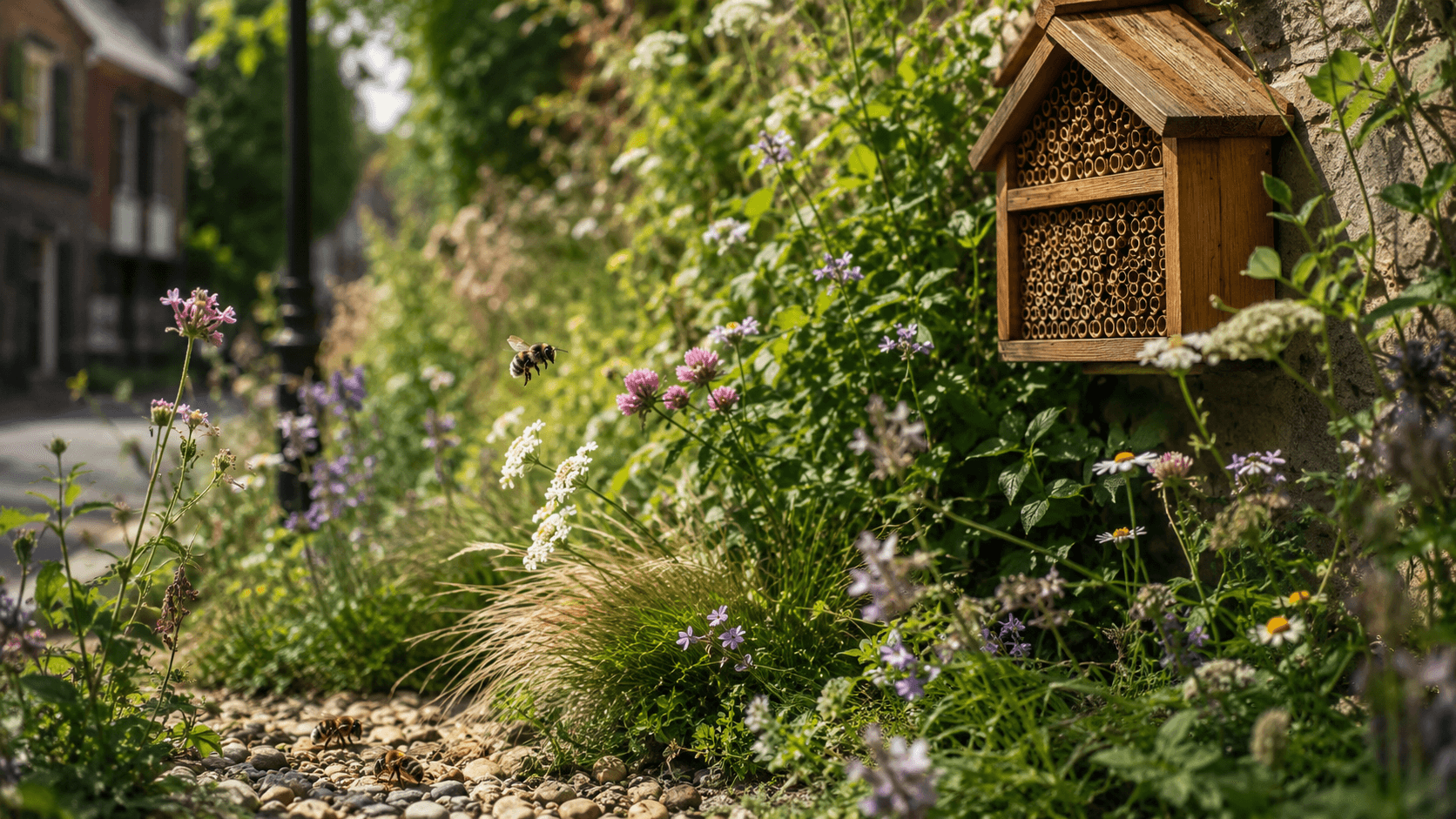
4. A Properly Built Bug Hotel — Not a Decorative One
Bug hotels are the feature most people get visibly wrong, mostly because the ones sold in garden centres are designed to look charming rather than function as nesting habitat. Two facts change the calculus considerably.
First, around 90% of bee species in the UK and Ireland — and the great majority worldwide — are solitary, not social. They do not live in hives. They lay individual eggs in cavities, seal them with mud or leaf-paste, and the next generation emerges the following year. These are the species your bug hotel is for.
Second, what those species need is specific: hollow stems of varying diameters (3mm to 10mm), drilled hardwood blocks with smooth, splinter-free bores, and a mounted position that is dry, south or south-east facing, and at least a metre off the ground. A bug hotel hanging in shade, packed with pinecones and bark for visual appeal, will be empty in spring because it offers nothing nesting bees actually want.
The Xerces Society and Buglife both publish good guidance on building or buying ones that work. What we've found is that one well-built, well-sited hotel is worth more than three decorative ones distributed wherever there's a hook.
5. A Corner of Undisturbed Dead Wood
This is the feature that requires the most permission from the gardener — permission to leave something that looks untidy. A small log pile, ideally part-buried, in a quiet, semi-shaded corner is one of the most valuable wildlife features a garden can offer. It supports overwintering queen bumblebees, beetle larvae, fungi, and the entire decomposer chain that small gardens rarely make space for.
The principle is broader than log piles. A patch of long grass left uncut, a few hollow stems left standing through winter rather than tidied in autumn, a corner where leaf litter is allowed to accumulate — each of these is habitat that the standard tidy-garden aesthetic deliberately removes. Many bee species lay eggs in plant stems and overwinter there as larvae; cutting those stems back in October and bagging them for the brown bin removes next year's bees with them.
What we've found helps is designating one corner — even a square metre — as the "messy corner" and giving yourself permission, in advance, not to tidy it. The rest of the garden can be as kept as you like.
6. A Shallow Water Source with Landing Strips
Pollinators need water, and most garden water features are useless or actively dangerous for them. A pond with vertical sides drowns insects. A birdbath with smooth porcelain is a slip-and-fall risk. What works is something far simpler: a shallow dish, no deeper than the width of your thumb, with stones or marbles arranged so that landing surfaces sit just above the water line.
A terracotta saucer of the kind that goes under a flowerpot, half-filled with pebbles and topped up regularly through summer, is functionally perfect. Place it in dappled light near pollinator-attracting planting, not in the middle of a lawn where it will be forgotten or kicked.
Small thing, easily overlooked, surprisingly important — particularly through July and August dry spells.
7. A Patch You Choose Not to Mow
The "No Mow May" campaign has done useful work bringing this into mainstream conversation, but the principle is broader than one month. A lawn that is mown weekly, fed regularly, and treated for clover and dandelions is, in pollinator terms, a green desert. Dandelion flowers are one of the most important early-season nectar sources available to bumblebee queens emerging from hibernation. Clover is a major mid-season source. White-tailed and red-tailed bumblebees, in particular, depend on these in places where ornamental flowers are not yet open.
What we've found works in most gardens is not abandoning the lawn entirely — most households want some open green space — but designating a section, often along an edge or under a tree, that is mown only twice a year, in late summer and early spring. Within two seasons, that strip becomes meaningfully different from the rest of the lawn: more diverse, more textured, and considerably more useful to wildlife.
The visual transition matters too. A long-grass area with a clearly mown edge looks intentional. A lawn that's just been left to grow looks neglected. The difference is in the framing, and the framing is doing real work.
8. A No-Spray Commitment, Especially Around Flowering Plants
The eighth feature is the easiest to implement and the one with the largest single effect. Garden chemicals — particularly systemic insecticides containing neonicotinoids or their successors — persist in plant tissue including pollen and nectar. A plant treated to deal with greenfly delivers that same chemistry to every bee that visits its flower. Even spot-treatments and "bee-safe" products warrant scepticism; the evidence base for their actual safety in field conditions is, we've found, considerably thinner than the marketing suggests.
The simplest commitment is the cleanest: no chemical pesticides anywhere in the garden, and particularly nothing on or near plants in flower. Most pest problems sort themselves out within a season or two as predator populations — ladybirds, hoverflies, lacewings, parasitic wasps — establish themselves. The garden that does not spray develops a working pest-control system. The garden that sprays continually is one in which that system can never establish.
This is, we'd note, an area where short-term inconvenience produces medium-term gain. The first year of not spraying can look untidy. The third looks balanced.
Putting the Eight Together
Any one of these features in isolation does some good. The point of listing them together is that pollinator-friendliness is a system, not a checklist. A bug hotel without nearby food is decorative. Late-flowering perennials without a sunny pocket to warm up in get visited less. A no-spray policy without flower diversity supports a thin food chain.
What we've found is that gardens with most of these features in some form — even at small scale — outperform gardens with one or two showpiece elements by a wide margin. The creatures you want do their own due diligence: they go where everything they need is available within a short flight, and they pass over places that offer one or two things without the rest.
The placement question, where each of these features should sit, given your garden's specific orientation, existing structure, and microclimate, is the part most planting articles skip. We've found it's the part that decides whether the features actually work. For the plant-by-plant side of this, our note on plants that earn their keep in a temperate garden covers the perennials and shrubs we've seen consistently work in Atlantic conditions, and many of them appear on the RHS Plants for Pollinators list as well.
Related Notes
- Plants That Earn Their Keep in a Temperate Garden
- Plant Hardiness in Ireland: A Beginner's Guide to What the Ratings Actually Mean
- What Do the Symbols on Your Plant Label Actually Mean?
- Low Maintenance Garden Ideas by Climate Zone: What Actually Thrives Where
If you'd like to see how this kind of planting and habitat layering would sit in your own garden, before you commit to any of it, that's exactly the problem the Dedrab tool is built to help with. Upload a photo and see a redesign that places features where they'll function. Try it at dedrab.com.
Sources & Further Reading
- Royal Horticultural Society — Plants for Pollinators lists and guidance: rhs.org.uk/wildlife
- Xerces Society for Invertebrate Conservation — pollinator habitat and nesting guidance: xerces.org
- Buglife — UK invertebrate conservation, including bee hotel and habitat advice: buglife.org.uk
- Goulson, D. (2014) — A Sting in the Tale, and ongoing research from the Sussex Bumblebee Lab on bumblebee ecology and decline
- Plantlife — No Mow May campaign and lawn diversity research: plantlife.org.uk