
What Is a Microclimate, and How Do You Use One in Your Garden?
On this page
Why This Matters in Your Back Garden
You bought the same plant twice. One thrived beside the back wall and flowered for years. The other, planted near the bottom of the lawn, was blackened by the first hard frost and never recovered. Same nursery, same label, same zone. It's easy to blame the plant, or yourself, but more often those two spots simply weren't the same place.
Our notes on the UK planting zone and hardiness zones for beginners explain what the zone numbers mean. This note covers what they can't: the variation inside your own boundary.
Why Can't One Zone Describe a Whole Garden?
A hardiness rating, whether an RHS H-rating or a USDA zone, is a broad guide built from regional climate data. It can't see your hollow, your south-facing wall or your neighbour's leylandii. University extension services make the same point about the US zone map: it doesn't account for microclimates, and topography, wind, buildings, hills and nearby water can all make a spot warmer or cooler than its official zone suggests. The University of Wisconsin's horticulture team describes a garden beside a lake, sheltered by trees and buildings, successfully growing plants from a zone warmer than the one it's officially in.
So treat the zone as your starting estimate and your own observations as the correction. If the labels themselves are confusing, see RHS hardiness versus USDA zones and what plant label symbols mean.
Which Microclimates Should You Look For?
Frost pockets
Cold air is denser than warm air, so on still, clear nights it drains downhill and collects in low spots. The RHS describes how this creates frost pockets that can shorten the growing season, and notes that a solid hedge or fence across a slope can trap cold air behind it. Making gaps so the air can drain away can ease the problem. University of Illinois Extension gives the same advice from the orchard side: sites where cold air settles are risky for frost-sensitive blossom, and slightly higher ground helps.
You don't need a dramatic hill. A gentle slope towards the bottom boundary, a sunken patio or a dip behind a wall can be enough.
Sun traps
A sheltered corner facing the sun, especially one backed by brick or stone, warms quickly and stays warm. The RHS notes that a south-facing wall absorbs heat by day and releases it at night, which can help protect against frost. This is where borderline-hardy plants tend to cope best. The direction flips in the southern hemisphere: in Australia, the north-facing wall gets the sun.
The flip side is dryness. The RHS points out that walls can create a rain shadow close to their base, so soil there can be very dry and may need extra watering while plants establish.
Wind tunnels
Wind is often the overlooked factor. The RHS describes wind as more damaging to plants in Britain than other forms of stress, and says a permeable windbreak shelters a much longer distance than a solid barrier. Solid fences can create turbulence on the lee side rather than calm. A side passage or the gap between buildings can funnel wind, so tender or tall plants may struggle there even when it's mild.
Urban warmth
Towns and cities are usually a little warmer than the surrounding countryside at night. As the Royal Meteorological Society's Metlink resource explains, brick, concrete and paving soak up heat in the day and release it slowly, and the difference is greatest on clear, calm nights and much smaller on cloudy, windy ones. A built-up garden may get a few degrees of extra protection compared with a rural one in the same zone. That's a reason to try slightly more tender plants, not a guarantee.
Shade and water
Shade from trees and buildings keeps ground cooler in summer and can leave it dry under thirsty trees. The RHS notes that tree and hedge shade resembles woodland conditions, which suits shade-lovers but not sun lovers; our guide to what will grow in a north-facing garden goes deeper. Large bodies of water change temperature more slowly than land, which can moderate extremes nearby, though damp, cold air can also gather in low ground by a stream.
How Do You Map Your Garden's Microclimates?
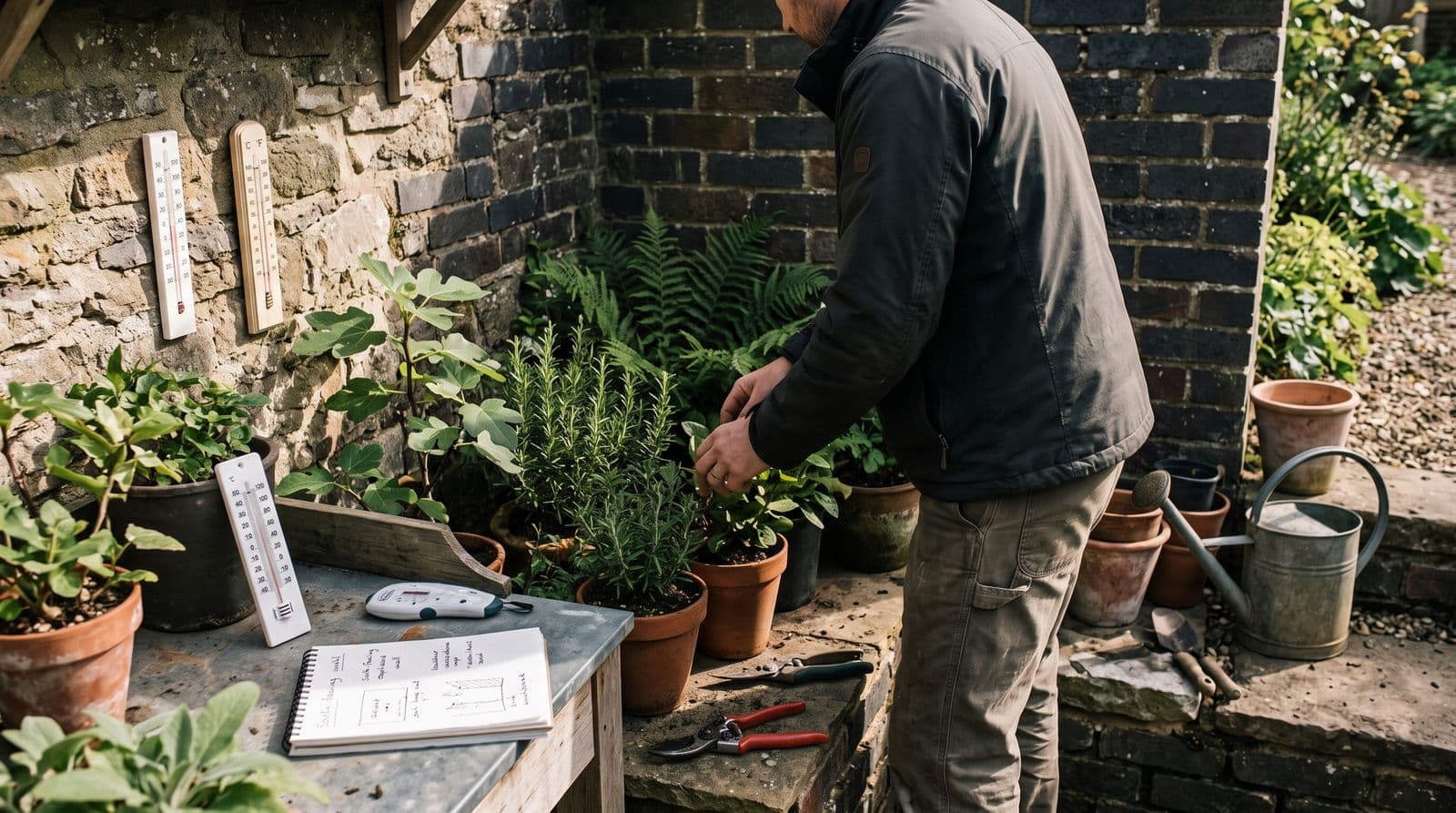
You don't need instruments. We've found a simple notebook method gets you most of the way, and the RHS suggests a similar approach: observe the surroundings, use a compass for orientation, look for wind-bent trees and check for watercourses in low ground.
- Sketch the plot. A rough bird's-eye outline with the house, boundaries, trees and any slope. Add north.
- Photograph the light. Take photos from the same spot in morning, midday and late afternoon, and repeat in different seasons. Low winter sun reaches very different places from the high summer sun.
- Check after the first frost. On a clear, cold morning, walk the garden early. Note where frost lingers, where it melted first and where it never formed.
- Note the wind. After a windy day, see where leaves pile up and where plants are bent.
- Watch the water. After heavy rain, record where it pools and where soil stays bone dry, especially under walls and eaves.
- Colour in the map. Mark warm and sheltered, cold and low, windy, and dry zones. A cheap min-max thermometer in two or three spots can confirm what your eyes suggest.
Doing this across autumn, winter and spring gives a far more honest picture than any single afternoon.
How Do You Use the Map to Place Plants?
- Borderline-hardy plants (rated just on the edge for your area) go in the warm, sheltered spots, ideally against a sunny wall, away from frost pockets and wind.
- Frost-sensitive early bloomers, such as magnolias or early-flowering fruit blossom, do better away from the frost pocket, where a late frost won't catch the flowers.
- Hardy, tough plants can take the cold hollow and the windy gap. Choose well-proven plants there rather than gambling.
- Fix before you plant. A hedge blocking cold air drainage might be improved by opening a gap. A solid windbreak might do better as a more permeable screen.
- Be honest about risk. Placement improves your odds but doesn't remove them. Mulch, fleece in cold snaps and slightly bigger plants all help, and it's worth treating any borderline plant as an experiment.
By region
The idea is the same everywhere, but what your microclimate is worth changes with where you live.
UK: mild coasts versus frosty inland hollows
The Met Office notes that places in the east and south of the UK tend to be drier, warmer, sunnier and less windy than those further west and north. Frost is where local differences bite hardest. In South West England, the Met Office reports that the Isles of Scilly average fewer than 2 air frosts a year, while low-lying inland spots in Somerset exceed 50. In the Midlands, air frost runs from about 40 days a year in the lower Severn valley to over 60 in the Peak District and sheltered Welsh Marches, and cold air draining into the Severn, Wye and Avon valleys adds to the frostiness of the western Midlands. In practice: on a mild Atlantic coast, a sun-trap wall may let you stretch to tender plants; in an inland valley, the frost hollow is the bigger risk, and a spot only a few metres higher can be the difference.
Ireland: Atlantic coasts versus the interior
Met Éireann says the Atlantic's influence is strongest near the coasts and fades with distance inland, and that air frost is not infrequent at inland locations even in May. For you, that means a coastal garden is more likely to have a mild winter but a windy one, so shelter matters most, while an inland garden should treat late-spring frost as a real risk for blossom and young growth.
US: valleys, lakes, cities and slopes
Purdue Extension describes frost pockets in the Midwest where cold air settles in valleys and low areas on clear, windless nights, with temperatures as much as 15°F cooler than nearby high ground. It also reports that Lake Michigan delays the first autumn freeze in north-west Indiana by roughly 2 to 3 weeks and reduces late spring frost damage. South-facing slopes warm earlier and reach higher temperatures than north-facing ones. In the south-east, University of Georgia climate specialists note that lakes can hold heat and prevent frost just downwind, and that frost often shows in suburbs while city centres stay frost-free. So in the US, check your distance to big water, your slope and whether you're in a bowl before leaning on your zone.
Australia: frost hollows in the south
The Bureau of Meteorology says frost is a localised phenomenon, fairly common in parts of southern Australia, and that frost hollows commonly form in valleys because dense cold air drains downhill, so frost can form in valleys while the surrounding area stays frost-free. Most Australian frost is radiation frost on clear, still nights, which is exactly the situation where a low corner of your garden suffers. Remember to flip the wall advice: in the southern hemisphere, the north-facing wall is your warm spot.
Frequently Asked Questions
What is a microclimate in a garden?
It's a small area where temperature, wind, light or moisture differ from the surrounding conditions. Frost pockets, sunny walled corners and windy gaps are common examples, even within a small plot.
How do I find a frost pocket in my garden?
Look for low ground where cold air can settle, or where a hedge or wall blocks downhill air flow. The simplest check is to walk the garden after a clear, cold night and note where frost lingers longest.
Does a south-facing wall really protect plants?
Yes, it can help. Masonry absorbs heat in the day and releases it overnight, which may soften cold. It isn't a guarantee, and the soil at the base can be very dry. In the southern hemisphere, the equivalent is a north-facing wall.
Are town gardens warmer than country gardens?
Often slightly, particularly on clear, calm nights, because buildings and paving store and release heat. The effect shrinks on cloudy, windy nights, so treat it as a bonus rather than something to rely on.
Can I grow borderline-hardy plants in a cold garden?
Sometimes. Use the warmest, most sheltered spot, protect the plant in winter and accept some risk. Keep anything you'd be heartbroken to lose out of the coldest hollow.
Related Notes
- What Planting Zone Is the UK In?
- Plant Hardiness Zones: A Beginner's Guide
- What Will Grow in a North-Facing Garden?
- RHS Hardiness vs USDA Zones
References
- Royal Horticultural Society, Microclimates: assessing your garden
- University of Wisconsin-Madison Division of Extension, Horticulture, Five considerations for plant hardiness zones and your garden
- University of Illinois Extension, Orchard tree series: Location, location, location
- Metlink (Royal Meteorological Society), Using WOW to Illustrate the Urban Heat Island Effect
- Met Office, UK regional climates
- Met Office, South West England: climate
- Met Office, Midlands: climate
- Met Éireann, Climate of Ireland
- Purdue Extension, Microclimates (HO-203-W)
- University of Georgia Extension, Microclimates of frost
- Bureau of Meteorology, About frost
See It in Your Own Garden
Notes and sketches are useful, but it's hard to see how everything fits until it's on a layout. Dedrab starts from a photo of your own garden and builds a redesign and planting plan around the spaces it can see, including walls, boundaries and light. If you'd like to see how your observations translate into a real layout, you're welcome to try it at dedrab.com, with no pressure to do so before you've finished your own frost-watching.