
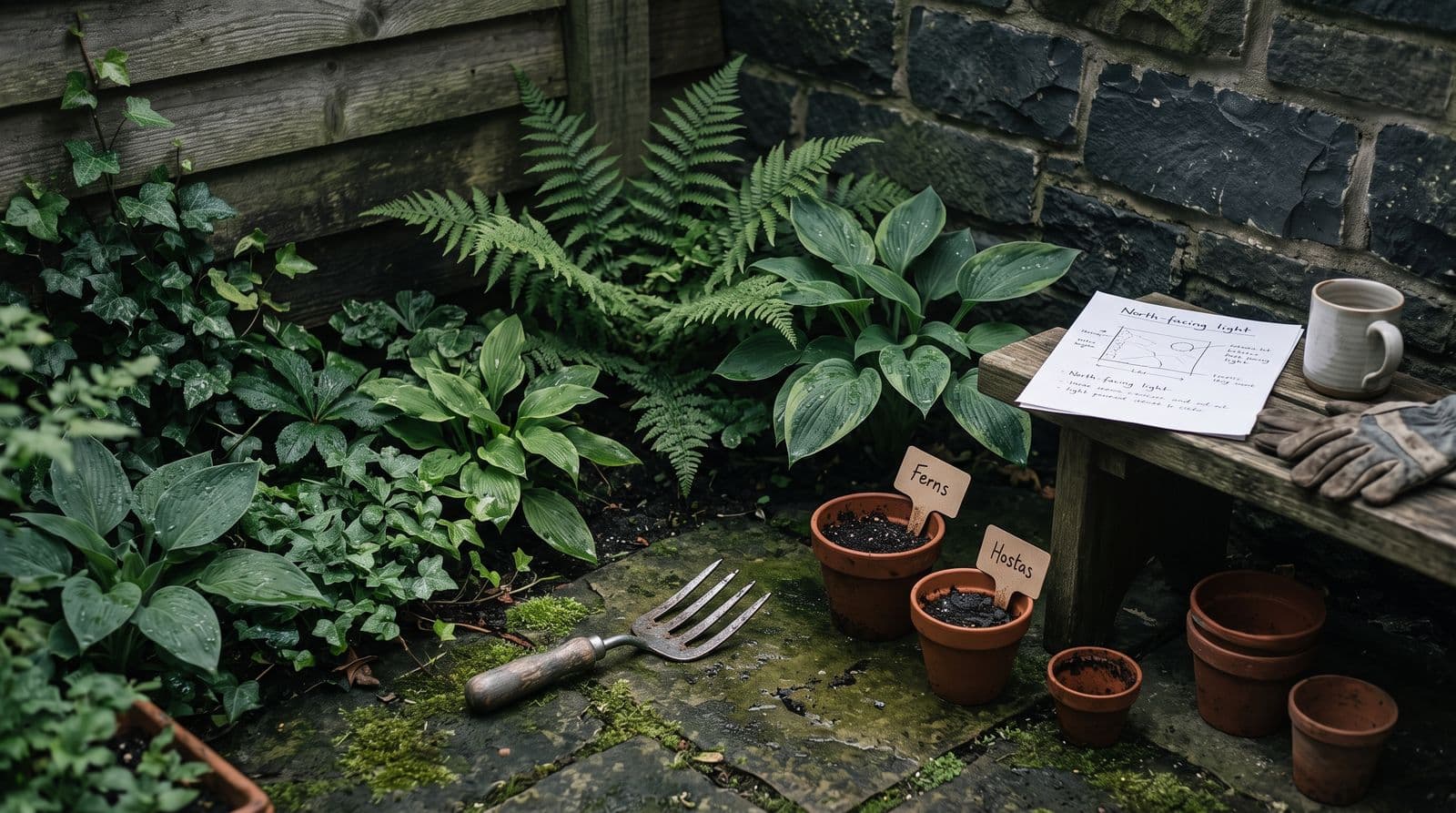
What Will Grow in a North-Facing Garden?
On this page
- Why Does a North-Facing Garden Feel So Hard?
- How Much Shade Do You Actually Have?
- Is a North-Facing Border Dry or Damp?
- Which Plants Suit Which Job?
- What Mistakes Should You Avoid in Shade?
- How Does the Light Change Through the Year?
- By region
- Frequently Asked Questions
- Related Notes
- See It in Your Own Garden
You've stood at the kitchen window and looked at it for a couple of seasons now: the bed along the back of the house where nothing seems to settle. The lavender sulked, the roses got leggy, and the one thing that thrived turned out to be moss. It's tempting to conclude that a north-facing garden is a lost cause. It isn't. It just needs a different shopping list.
Why Does a North-Facing Garden Feel So Hard?
Most disappointing shady borders have the same story: sun-loving plants chosen for a spot that never gave them the light, or shade plants chosen without noticing that the soil was bone dry. Neither is a failing on your part. Garden centres tend to sort plants by season and colour, not by the conditions at your particular wall.
In the northern hemisphere, a north-facing garden sits on the side of the house away from the sun for much of the day, so the border nearest the house can stay shaded for long stretches. The far end of the plot often catches more light, and the picture changes through the year. "North-facing" is a strong clue, not a verdict.
If you're in Australia or New Zealand, flip the compass. The sun tracks across the northern sky, so a north-facing garden is the bright, warm one, and your shady side is the south. Everything below applies to your shady side.
How Much Shade Do You Actually Have?
"Shade" is not one condition. The RHS describes light shade (open to the sky but screened from direct sun), dappled shade (filtered through an open canopy), partial shade (roughly 3 to 6 hours of direct sun at midsummer), moderate shade (about 2 to 3 hours) and deep shade (under 2 hours), in its guide to shade gardening. Each supports a different palette.
Two quick checks tell you most of what you need:
- Count the sun. On a clear day, note when direct light reaches the spot at about 9am, midday, 3pm and early evening. Photos work well. A border that looks gloomy at 8am may get a decent afternoon patch.
- Check the moisture. Dig down a spade's depth a couple of days after rain. Dusty means dry shade; sticky and cool means damp shade.
Is a North-Facing Border Dry or Damp?
This surprises people. The RHS notes that shade cast by trees is linked to dry soil because of root action, and that very close to walls (within about 40cm) conditions can be dry. North-facing walls can also create a rain shadow at their base, as the RHS says in its guide to award-winning plants for shady north walls. Utah State University Extension adds that soil under trees can be surprisingly parched because canopies shed water outwards while the tree draws on what's underneath, in its guide to landscaping in dry shade.
So a bed hard against the house is usually dry shade, while a low corner or the shaded side of an open lawn is more likely to be damp. Treat them as two different borders.
Which Plants Suit Which Job?
Rather than hunting for a generic list of "shade plants", think about what each part of the border needs to do. Always check the plant label for the light and soil it prefers.
Structure: the backbone
For north-facing walls, the RHS highlights Osmanthus delavayi (H5), Itea ilicifolia (H5), Azara serrata (H4, needing shelter from icy winds), climbing hydrangea (Hydrangea petiolaris, H5), variegated ivy and Euonymus fortunei 'Emerald 'n' Gold' (H5). Pale or variegated foliage is a useful trick, because it bounces what light there is around.
Ground cover: closing the gaps
Bare soil in shade invites weeds and moss. The RHS suggests ground-covering perennials such as Lamium maculatum 'Beacon Silver' and sweet violet (Viola odorata) in its guide to shade planting. Lady's mantle (Alchemilla mollis) appears on both the RHS list and the Utah State dry-shade list, which is a good sign of adaptability.
Flowers: yes, there are plenty
Shade isn't flowerless. The RHS lists Astrantia maxima, hardy geraniums, hostas and Japanese anemones, plus bulbs for early colour including snowdrops, winter aconites, Cyclamen hederifolium, Scilla sibirica and narcissi. Utah State's dry-shade list adds columbine, foamflower, coral bells (heuchera) and barrenwort (epimedium). Many sun-lovers survive in light shade but flower less.
Ferns and foliage: the shade specialists
According to the RHS, hart's tongue, painted lady and many Dryopteris ferns suit damp shade, while golden-scaled male fern, polypody and soft shield fern cope with dry shade. Ferns and hostas make a calm, layered scheme that suits a Japanese-inspired or woodland design as well as a cottage one. Our note on plants that earn their keep in a temperate garden shows how to build in seasonal interest.
What Mistakes Should You Avoid in Shade?
- Planting for the label, not the light. "Partial shade" on a tag usually means a few hours of sun, not a permanently dim corner.
- Forgetting the water. New shade plants still need regular watering through their first season, especially in a rain shadow or under trees.
- Fighting the shade. Forcing roses, lavender or most herbs into deep shade ends in thin growth. Work with it instead.
- Choosing only dark foliage. Mix in pale leaves, silver markings, white flowers and variegation.
- Planting one of everything. Repeat a few reliable plants in drifts; it looks calmer and covers ground faster.
- Overlooking edibles. The RHS notes that raspberries, blackcurrants, redcurrants and gooseberries tolerate light shade, and Morello cherries and 'William's' pears suit north and east-facing walls.
How Does the Light Change Through the Year?
A north-facing garden isn't static. In summer the sun rides high and swings wider, so spots that were gloomy in winter may pick up early or late sun. In winter the sun sits low and some borders may get almost no direct light for weeks. Deciduous trees add another layer: spring bulbs flower in the bright window before the canopy closes, which is why woodland-style planting works so well.
Assess your shade at more than one time of year, ideally photographing it in spring, midsummer and late autumn. Tall neighbouring buildings, fences and evergreen hedges complicate things whichever side of the equator you're on.
By region
The shade logic is the same everywhere, but the plants that cope differ with winter cold, summer heat and rainfall.
United Kingdom
Hardiness is the main regional lever. The RHS ratings above range from H4 to H5 for most north-wall shrubs and climbers, and the RHS notes that Azara serrata (H4) needs shelter from icy winds. In colder, more exposed parts of northern England, Scotland and inland areas, we'd lean towards the H5 and hardier options, such as Osmanthus delavayi and climbing hydrangea, rather than the H4 plants. Our guide to RHS hardiness ratings across the UK explains how to read them.
Ireland
Irish gardens often sit in shade of a different kind. One Irish News gardening column notes that Ireland's cloudy climate means gardens are in semi-shade most of the time, with grey skies outnumbering blue. It suggests lungwort, Geranium phaeum 'Joan Baker', Clematis alpina 'Blue Dancer', royal fern and periwinkle (pruned in spring to control its vigour), and stresses telling damp shade from dry shade, which needs organic matter. See our note on hardiness zones in Ireland for rating guidance.
United States
Two contrasting regions show how much shade planting shifts. In the Pacific Northwest, a Washington State University Extension column warns that dense cover keeps rain off the ground, so deeply shaded areas are relatively dry and shade gardens need a little more watering than open ground. It suggests hostas, bleeding heart, Solomon's seal, astilbe and hellebores, and shrubs such as rhododendrons and camellias. In the South, NC State Extension advises planting hostas in full or dappled shade so foliage colours stay vibrant and don't burn, and notes that hostas need a cool winter dormancy, so they are listed for USDA zones 3 to 9. Our RHS-to-USDA translator helps with converting ratings.
Australia
The shady side is the south. On Gardening Australia, Josh Byrne describes dry shade as particularly challenging and shows a south-side bed planted with mother-in-law's tongue (Sansevieria trifasciata), fruit salad plant (Monstera deliciosa) and snake vine (Hibbertia scandens). He digs in compost, adds a wetting agent for water-repellent soil and mulches; once established, the bed needs no irrigation. These tropical-leaning plants will suit warmer states, but check hardiness locally before copying them in cooler areas.
Frequently Asked Questions
What are the best plants for a north-facing garden?
Ferns, hostas, hardy geraniums, lady's mantle, snowdrops, cyclamen and evergreen climbers such as climbing hydrangea are reliable choices. Pick damp-shade or dry-shade ferns and perennials to match your soil moisture.
Does a north-facing garden get any sun at all?
Yes, though less than other aspects. The part nearest the house may be shaded for long periods in winter, while the far end and summer evenings often receive more direct light.
Can you grow fruit or vegetables in a north-facing garden?
Some. The RHS lists raspberries, blackcurrants, redcurrants and gooseberries as tolerating light shade, and Morello cherries and 'William's' pears for north or east-facing walls. Lettuce, kale, spinach, beetroot and peas also tolerate light shade. Keep tomatoes for your sunniest spot or containers.
What does "north-facing" mean in Australia or New Zealand?
The sun is in the northern sky, so a north-facing garden is the sunny one. Use this guide for the south-facing side of your house.
How do I improve dry shade?
Dig in compost before planting, water new plants in thoroughly, mulch to hold moisture and choose dry-shade plants such as golden-scaled male fern, polypody and lady's mantle.
Related Notes
- What Planting Zone Is the UK In? RHS H3 to H7 Explained
- What Planting Zone Is Ireland In? RHS H4 and H5 Explained
- RHS Hardiness vs USDA Zones
- Plants That Earn Their Keep: What We've Found Thrives in a Temperate Garden
References
- Royal Horticultural Society, Shade Gardening Tips and Plant Ideas
- Royal Horticultural Society, 10 award-winning plants for shady north walls
- Royal Horticultural Society, Shade planting: annuals, bulbs and perennials
- Utah State University Extension, Landscaping in Dry Shade
- ABC, Gardening Australia, Dealing with Shade
- Irish News, The casual gardener: even in Ireland we need to take shade into account
- Washington State University Extension, Deep Shade Gardening
- NC State Extension, Hosta (Hosta, Plantain Lily)
See It in Your Own Garden
Reading light, soil and aspect is the hard part. If you'd like to see it worked through for your own plot, the Dedrab Garden Action Plan starts from a photo of your garden, looks at the walls, trees and light visible in the image, and suggests a redesign and planting plan chosen for your climate and design style. Always check a plant label before buying. Try it at dedrab.com.