The Real Cost of Redoing a Small Garden (And What Actually Drives It)
On this page
The question we hear most often, just before someone decides to actually get on with their garden, is some version of: "What's it going to cost me?" It's a reasonable question, and a difficult one to answer well — because the honest answer is that the cost of redoing a small garden depends almost entirely on decisions you haven't made yet.
What we can do is break it down. Once you understand what the cost is actually made of, you can make smarter decisions about where to spend and where to save — and you will stop being surprised by quotes.
The Three Cost Buckets
Every garden project, regardless of size, breaks into three broad buckets: hard landscaping, soft landscaping, and labour. The ratio between them varies wildly depending on what you're doing, but understanding these three separately changes how you think about a budget. Our note on hard landscaping vs soft landscaping covers the distinction in more depth, and why one always runs before the other.
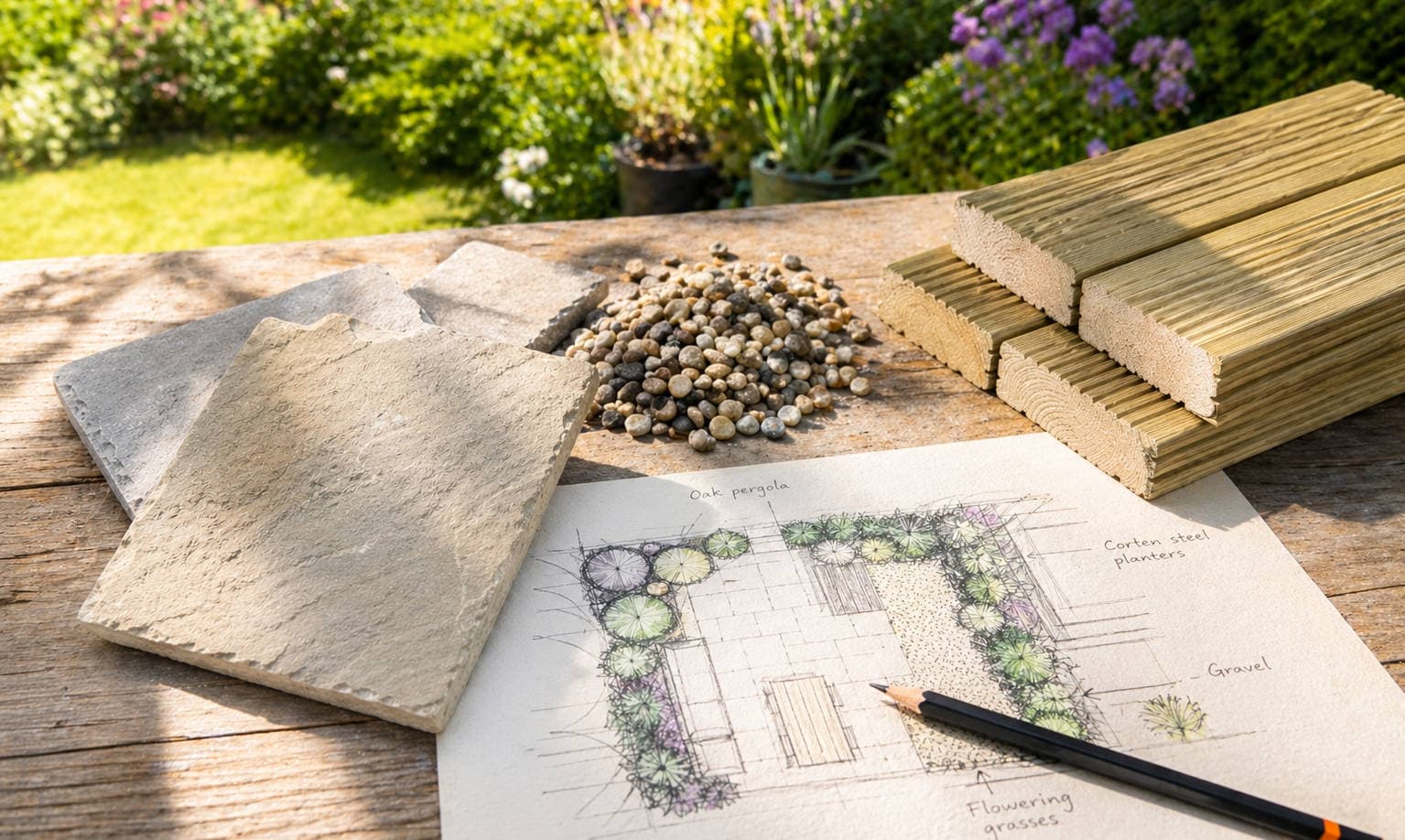
Hard landscaping is everything structural — paving, decking, raised beds, walls, fencing, steps, drainage. This is the expensive part, and it's the part that's hardest to phase or cut back on once you've committed to a layout. Materials here carry a wide price range: the gap between a budget paving slab and a natural stone equivalent can be three or four times the cost per square metre, with a look that's immediately apparent. What we've found is that hard landscaping is where most people underestimate — they price the materials but forget to account for the groundwork underneath them.
Soft landscaping is plants, soil, mulch, turf or seed. This is the most flexible bucket — you can always start with fewer plants and add more as the budget allows, because plants grow. A garden planted at 40% of its eventual density in Year 1 will look full and established by Year 3. The cost here is more manageable than people expect, particularly if you're open to smaller plant sizes and a little patience.
Labour is the one that tends to shock people who haven't hired trades before. Ground preparation, levelling, laying, planting — skilled garden contractors are in demand and their day rates reflect it. A project that costs a certain amount in materials might cost the same again, or more, in labour. If you have the time and the physical capability, doing some of the groundwork yourself can make a meaningful difference. If you don't, it's better to know that upfront and budget honestly.
What Drives Cost Up
A few specific things have an outsized effect on what a small garden redesign ends up costing, and they're worth naming plainly.
Existing surfaces that need to come out. Breaking up old concrete or paving, disposing of the rubble, and dealing with what's underneath adds cost before a single new thing goes in. What we've found is that people often price the new garden but forget the cost of removing the old one.
Level changes. A flat garden is significantly cheaper to work with than a sloped one. Steps, retaining walls, and grading all add complexity and cost. Even a modest slope can add a meaningful percentage to a project.
Ground conditions. Clay-heavy soil, poor drainage, or roots from an overhanging tree create extra work at every stage — from digging beds to laying hard surfaces to establishing planting. You won't always know what you're dealing with until you start.
Access. If materials can only be brought through the house or via a narrow side passage, delivery gets harder, skips get more expensive, and the project takes longer. Access is one of those things that seems irrelevant until it isn't.
Lighting and irrigation. Often added as an afterthought, and always more expensive when retrofitted than when included from the start. If you think you'll want either, plan for the groundwork now even if you defer the installation itself.
Where You Can Reasonably Save
Budget doesn't have to mean compromise in the places that matter most. What we've found is that the smartest savings tend to come from timing and flexibility rather than cutting corners on quality.
Buy plants small. A 2-litre perennial planted well in prepared ground will often outperform a 5-litre plant shoved into poor soil with no aftercare. The cost difference is significant; the result difference, after a season or two, is minimal.
Phase the hard landscaping. If the budget doesn't stretch to full paving now, gravel is a legitimate interim surface that can be removed and replaced later. It keeps the space usable and looking intentional while you save for the permanent solution.
Do your own prep work. Clearing, weeding, and even breaking up old surfaces are jobs that don't require specialist skill — just time and effort. Handing the contractor a cleared, accessible site rather than a jungle saves real money.
Choose materials that earn their cost. Spend on the surfaces you'll see and touch daily — the main patio, the path to the door. Be more flexible on the materials used at the back of the border or along a boundary fence. Nobody is looking at the fence panels as closely as the patio.
The Budget Conversation Most People Avoid
The thing that derails more garden projects than anything else is not setting a budget before you start. Not a vague "I'd like to keep it reasonable" budget — a real number that represents what you are genuinely able and willing to spend.
That number shapes every decision that follows. It tells you whether you're doing the whole garden or just the anchor space. It tells you whether you're using natural stone or concrete alternatives. It tells you whether you're hiring a contractor for the full job or doing some of it yourself.
What we've found is that people who set a clear budget early tend to end up happier with the result, not because they spent more, but because every decision was made in relation to something real rather than in a vague hope that it would all come in fine.
Set the number. Build the project around it. The garden you can actually afford to make is the one you'll actually make. Our fuller garden design cost breakdown for 2026 covers the per-element price ranges across UK, US and Australian markets if you want to pressure-test your number against the typical bands.
Related Notes
- Garden Design Cost Breakdown 2026: What a Garden Renovation Actually Costs
- Before You Hire a Landscaper: The Questions You Should Be Able to Answer First
- Hard Ground, Soft Touch: Understanding What Your Garden Is Actually Made Of
- DIY Garden Makeover Plan: A Realistic Weekend-by-Weekend Guide
- Where the Money Actually Goes in a Mid-Size Garden Renovation
- Cheap Garden Ideas That Don't Look Cheap
The cheapest place to spot a budget mistake is on paper, before the contractor's quote arrives. Dedrab turns a single photo of your garden into a costed action plan with materials, planting and phasing laid out. Try it at dedrab.com.