
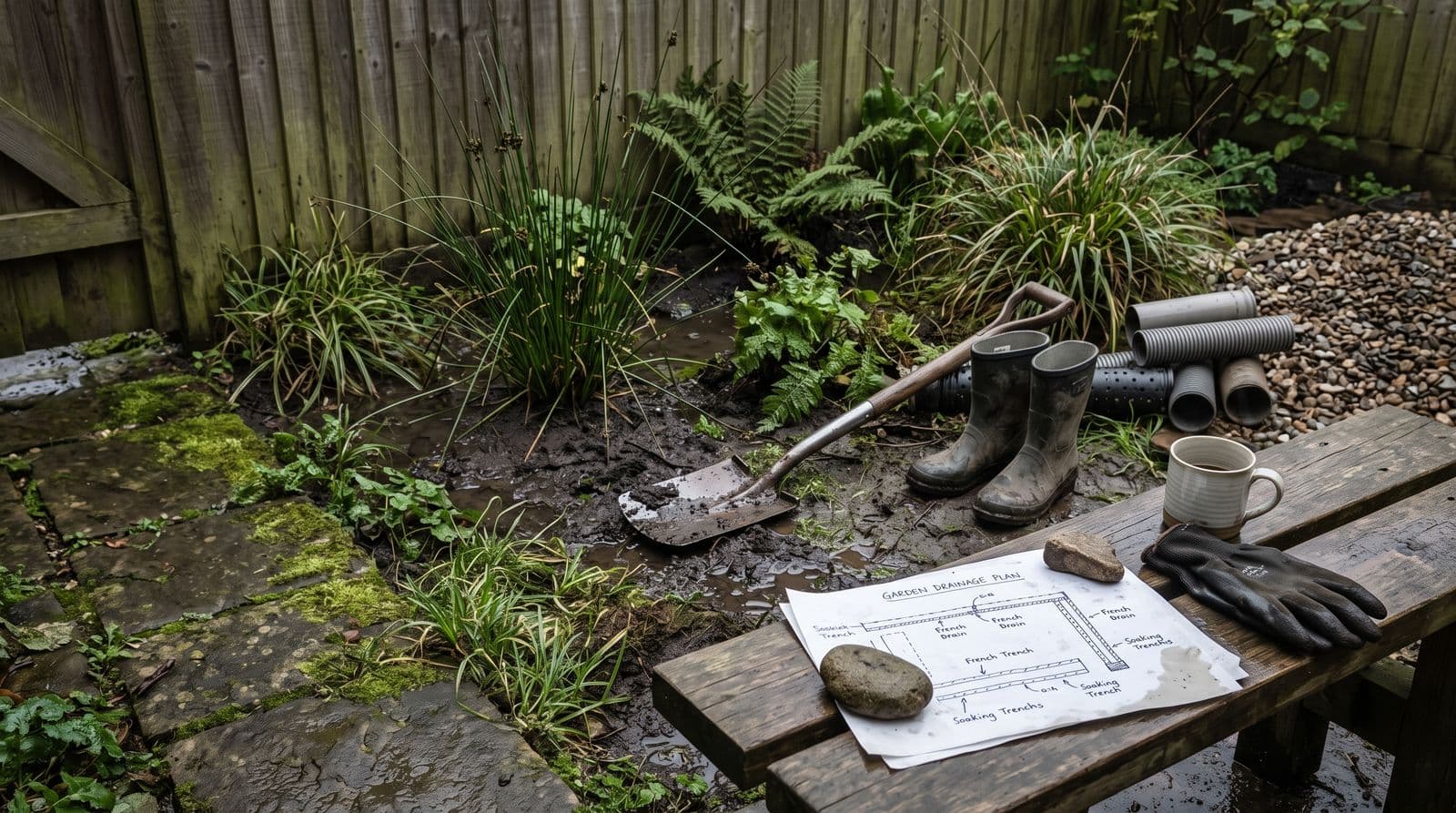
How Do You Fix a Boggy or Waterlogged Garden?
On this page
A waterlogged garden rarely announces itself in summer. It shows up in October, when the first run of proper rain arrives and the lawn starts to squelch underfoot. Puddles that used to clear by lunchtime are still there the next morning. The border by the fence has turned to sludge, and a shrub you planted in spring is yellowing for no obvious reason.
Why Does Your Garden Stay Waterlogged?
Most plants need air in the soil as well as water. When soil stays saturated, the air is pushed out and roots struggle. The Royal Horticultural Society (RHS) notes that waterlogged soil is often compacted or naturally dense, and that damage tends to be worse in the growing season, when roots need more oxygen, than in cold winter conditions. A spot that looks merely "a bit damp" in winter can quietly kill plants in spring and summer.
It helps to know which of these is behind your problem, because the fixes differ.
- Compaction. Foot traffic, building work, machinery and digging when the soil is wet all squeeze out the pores that let water drain. University of Illinois Extension points out that working saturated soil can create dense layers that block drainage.
- Clay or dense soil. Clay has very small pores, so water moves through it slowly.
- A high water table. In low-lying land, or near a river or spring, groundwater can sit close to the surface for much of the winter.
- Runoff and hard surfaces. The RHS points out that hard landscaping reduces the soil area available to absorb rain, concentrating water in smaller zones. A new patio, driveway or extension can change where water goes.
- Low spots. Water runs downhill and collects where the ground dips, whether in your garden or from a neighbour's.
Often it is a combination. A compacted layer of clay at the bottom of a hollow is a classic recipe for a bog.
How Do You Test Your Drainage Before Spending Anything?
A simple hole test tells you far more than guessing. The method below follows guidance from Iowa State University Extension, adapted to metric.
- Dig a hole roughly 30cm (12in) deep and 10 to 30cm wide.
- Fill it with water and let it drain away completely. This pre-wets the soil.
- Fill it again straight away and note the water level.
- After 15 minutes, measure how far the level has dropped, and multiply by four to estimate the drop per hour.
Iowa State describes a drop of roughly 2.5 to 7.5cm (1 to 3in) an hour as desirable for most plants, and less than about 2.5cm (1in) an hour as poor drainage. Treat these as rough guides rather than exact thresholds.
Test in a few places, and again after a wet spell, because one spot can behave very differently from another. Dig a second, deeper hole in your worst area too. If water seeps in from the sides or the bottom, that points towards a high water table rather than just dense topsoil. Take photos and note where water lies after rain; that record is extremely useful later, whether you are planning a layout yourself or briefing a professional.
What Should You Try First, and in What Order?
1. Stop making it worse
Keep off saturated soil and lawn where you can, and avoid digging or rotovating when it is wet. Use boards or stepping stones on regular routes. It costs nothing and prevents further compaction.
2. Improve the soil structure
Both the RHS and university extension services recommend adding organic matter. Iowa State suggests working a few inches of compost into the top 15 to 30cm of soil to improve structure and pore space, and Illinois Extension notes that aeration or tillage can break up hardpans. Do this when the soil is moist rather than sodden. It helps with compaction and moderately heavy ground, but it won't rescue a plot sitting on a high water table.
3. Plant for the conditions
Often the most cost-effective answer is to stop fighting the wetness. See the plant section below.
4. Raise your beds
When you can't change the ground, change the level. The RHS suggests raised beds as an effective option for poorly draining sites. Lifting roots above the wettest soil gives them air, and it is an approachable DIY job. A bed on a permanently saturated base can still be wet at the bottom, so choose plants accordingly.
5. Build a rain garden, swale or seasonal pond
If water collects at a low point anyway, give it somewhere useful to go. The RHS lists seasonal ponds and rain gardens at a garden's low points among its drainage options, and Iowa State also suggests redirecting surface water through rain gardens or reshaping depressions. A shallow planted dip, or a gentle swale that carries water to it, holds rain for a while and lets it soak away slowly. This suits surface-water problems rather than a permanently high water table.
6. Install drains or a soakaway (last)
Land drains, French drains and soakaways can move large volumes of water, but this is structural work. They need the right fall, a suitable place for the water to end up, and soil that can absorb it. A badly sited soakaway can send water to a neighbour's land or simply fill up and fail. We'd strongly suggest professional advice. Our note on what to ask before you hire a landscaper covers how to brief someone, and our cost breakdown shows where groundwork tends to sit in a budget. If flooding appears to come from an overflowing public drain, the RHS suggests contacting your water company.
When Should You Call a Professional?
Get advice if water stays on the surface for days, if it reaches your house or outbuildings, if you suspect a spring or high groundwater, or if the fix involves digging trenches or channelling water off your property. In some places, planning, building or water regulations also apply to drainage and to surfacing over a front garden, so check what applies locally. For smaller problems, better soil care, raised beds and the right plants are often enough, and we've found that matching the solution to the real cause saves a lot of wasted effort.
Which Plants Tolerate Wet Soil?
Some plants like moist soil, some tolerate seasonal waterlogging, and a few cope with standing water. Most "bog garden" plants like wet soil but not swimming in water, as the RHS puts it, so a spot under water for long periods may need a more aquatic approach.
The RHS bog garden list includes, among many others:
- Perennials: astilbe, rodgersia, ligularia, hostas, Siberian and yellow flag iris (Iris sibirica, Iris pseudacorus), candelabra primulas (Primula japonica, P. florindae), meadowsweet (Filipendula ulmaria) and marsh marigold (Caltha palustris).
- Grasses and sedge-like plants: Carex elata 'Aurea' and soft rush (Juncus effusus).
- Ferns: royal fern (Osmunda regalis), ostrich fern (Matteuccia struthiopteris) and male fern.
- Trees: the RHS mentions willows for persistently wet areas, and Iowa State names bald cypress as a tree for wet soils.
For ground that swings between wet and dry, the RHS has a separate list for seasonally wet and dry soils, and notes that not every "suitable" plant works in every garden, so some experimenting is realistic. Check hardiness for your own climate too: our RHS and USDA comparison explains how to read the ratings.
By region
The fixes above work everywhere, but when and why gardens waterlog changes with your climate and soil.
United Kingdom
The Met Office notes that the west of the UK is more likely to receive rain from Atlantic weather systems, which lose intensity as they move east, and that mountains in the north and west force the prevailing westerly winds upwards, enhancing rainfall. Its observing sites in Snowdonia, the Lake District and the Scottish Highlands record more than 4 metres in a year. So gardens in western Scotland, Wales and Cumbria are more likely to stay wet for long stretches, and the sensible default there is to plan around the wet: bog planting and rain gardens first, raised beds for anything fussy. Gardens in the drier south and east waterlog more often through heavy clay, compaction or new hard surfaces than through sheer rainfall, so soil structure is usually the first thing to tackle.
Ireland
Met Éireann's 1991 to 2020 averages put Ireland's annual rainfall at 1,288mm, with winter and autumn the wettest seasons (an average of 380mm and 369mm) and spring the driest. Rainfall has risen by roughly 3 to 6 per cent in the east and 6 to 12 per cent across parts of the west and north compared with the earlier baseline, so wetter gardens in the west and north have, if anything, got wetter. The EPA reports that poorly drained mineral soils (gleys) make up about 24.5 per cent of Ireland's soils, and organic soils about 18 per cent. In practice, an Irish garden that squelches all winter is very often sitting on gley, which makes raised beds and bog-tolerant planting a more reliable route than expecting digging alone to cure it.
United States
Drainage problems follow soil and season, not just rainfall. In the Pacific Northwest, Washington State University Extension describes heavy clay soils that hold water strongly and recommends raised beds, which drain well and warm up earlier in spring. In the Midwest, the Iowa State and Illinois guidance used above applies directly, and bald cypress is a good tree for wet ground. Local rules on drainage, stormwater and soakaways vary by state and county, so check with your local authority before redirecting water.
Australia
Rainfall seasonality is the key difference. The Bureau of Meteorology classifies much of northern Australia as summer-dominant rainfall (a marked wet summer and dry winter), while much of the south is winter-dominant, and ABC Organic Gardener describes the tropical and subtropical east coast as having humid, wet summers. In practice, northern and east-coast gardens are most likely to waterlog in summer, while southern gardens are wettest in winter. Time your drainage tests for your own wet season, and check local council rules before changing drainage or stormwater flow.
Frequently Asked Questions
Why is my garden boggy in winter but fine in summer?
Rainfall is higher in winter and plants and evaporation take up less water, so a high water table or slow-draining soil shows itself. Summer dries it out, which is why a test hole after a wet spell is more revealing than one in August.
How do I test whether my garden drains well?
Dig a hole about 30cm deep, fill it, let it empty, refill it and measure the drop after 15 minutes. Multiply by four for a rough hourly rate. Around 2.5 to 7.5cm an hour is considered good for most plants, and under about 2.5cm is poor.
Will adding compost or sand fix waterlogged soil?
Compost will help; sand usually won't. Organic matter improves structure and is widely recommended, but sand added to clay in the wrong proportions can make the soil more like concrete. Neither will solve a high water table or heavy runoff on its own.
Do I need a soakaway?
Usually not. Only consider one if simpler measures haven't worked and the soil beneath can actually absorb the water. This is structural work, so take professional advice before spending money on one.
What can I plant in a permanently wet area?
Bog and marginal plants such as iris, astilbe, rodgersia, ligularia, royal fern and meadowsweet suit moist soil, and willows cope with persistently wet ground. Avoid plants that need sharp drainage unless they go on a raised bed.
Related Notes
- Before You Hire a Landscaper: The Questions You Should Be Able to Answer First
- DIY or Hire a Landscaper? How to Actually Decide
- Where Do You Actually Begin? A Practical Framework for Garden Redesign
- Garden Design Cost Breakdown 2026: What a Garden Renovation Actually Costs
References
- Royal Horticultural Society, Waterlogging and flooding
- Royal Horticultural Society, Bog gardens: plants for
- Royal Horticultural Society, Choose plants for seasonally wet and dry soils
- Iowa State University Extension and Outreach, Testing and Improving Soil Drainage
- University of Illinois Extension, Improving Soil Drainage
- Met Office, How much does it rain in the UK?
- Gov.ie (Met Éireann), Ireland has become warmer and wetter in the last thirty years
- Environmental Protection Agency, Ireland's State of the Environment Report 2024
- Washington State University Extension, Raised bed gardening: a good choice with Northwest soils
- Bureau of Meteorology, Climate classification maps
- ABC Organic Gardener, Understanding climate zones
See It in Your Own Garden
Once you know where the water lies, the next question is what to put where. A Dedrab Garden Action Plan starts from a photo of your own garden and lays out beds, planting and materials around your wet spots. It isn't a substitute for a drainage survey, but it gives you a clearer starting point and a better brief if you bring someone in. Try it at dedrab.com.